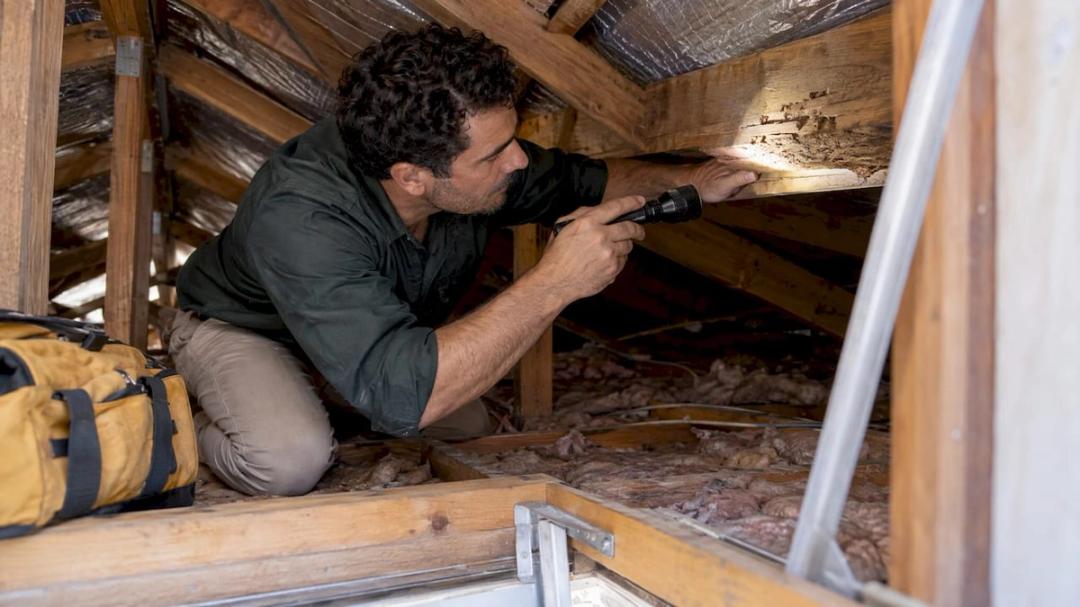
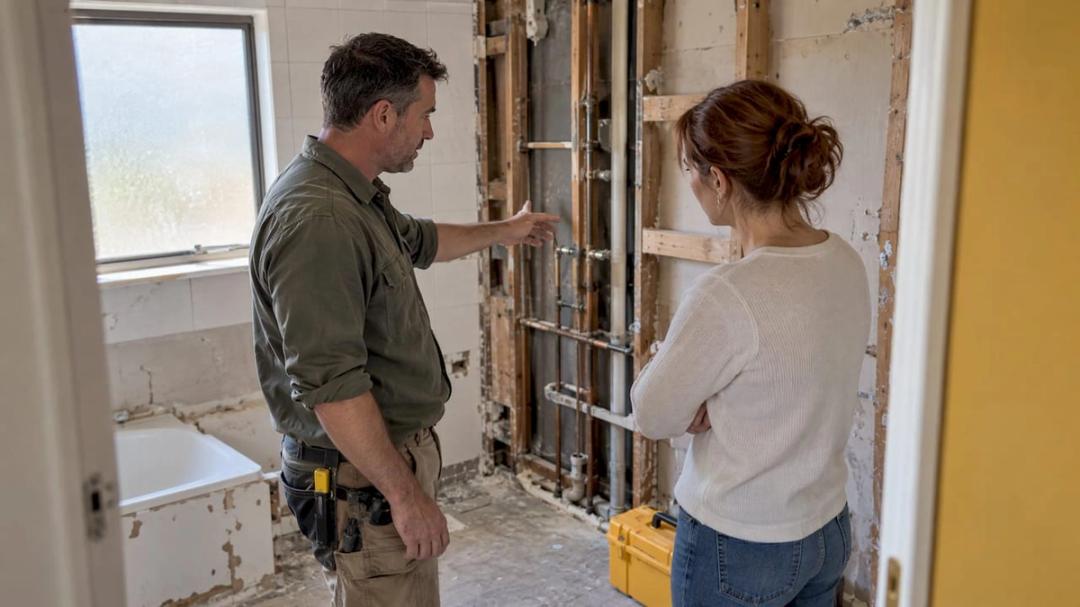
A good bathroom renovation builder holds the right licence for your state, carries the required insurance, quotes against written plans and specifications, and signs a contract that fixes price, stages and timeframes. Get those four things right and most of the risk in a bathroom job goes away. This guide shows you what to check, what a quote must contain, how to compare three quotes fairly and where budgets usually blow out. The same checks apply if you are hiring a kitchen renovation contractor.
Realestatehive Find Renovation Expertise in One Place Realestatehive connects you with property professionals and lets you compare profiles and reviews, helping you explore renovation expertise alongside your project needs. Explore property professionals
TL;DR
- A builder manages the whole job: supervising tradespeople, ordering and coordinating materials, and running the project from start to finish.
- Check the licence, ABN, insurance, references and who will actually supervise on site before you accept any quote.
- Send every builder the same written brief, then compare each line as included, excluded, prime-cost allowance or provisional sum.
- Keep a contingency on top of the quote. Scope creep and hidden problems behind walls and floors are the usual causes of overruns.
- Variations should always be agreed in writing before the work happens.
Table of Contents
- What a bathroom renovation builder actually does
- Licences, insurance and qualifications: what to check
- Building a shortlist
- How to get quotes you can actually compare
- Kitchen renovation contractors: the same logic, different line items
- Find a builder for your bathroom or kitchen
- What the contract should say
- Why bathroom budgets drift, and how to plan for it
- A step-by-step way to hire
- FAQ
- Sources
What a bathroom renovation builder actually does
A builder manages and oversees the renovation by supervising tradespeople, ordering and coordinating materials and managing the project from start to finish. In a bathroom that means one point of accountability across several trades that must happen in the right order.
A full bathroom scope commonly includes demolition, waterproofing, plumbing, electrical work, plastering, tiling, cabinetry, shower-screen and mirror glazing, painting, fixture installation and final fit-off. Whoever you hire, the exact scope has to be confirmed in writing, because “bathroom renovation” means very different things to different businesses. A cosmetic refresh that swaps tiles and a vanity is a different job from a strip-out and relayout with moved plumbing.
The words people use for this work vary: builder, contractor, renovator, bathroom specialist. What matters is not the label but whether the business holds the licence your state requires for the work you are asking for, and whether it will take responsibility for the whole job rather than one trade.
Licences, insurance and qualifications: what to check
Rules differ by state and territory, and thresholds change. Use the figures below as a guide, then confirm the current rule with your state regulator before signing.
| State | What the official guidance says |
|---|---|
| NSW | Most residential building or trade work over $5,000 must be done by a licensed contractor, a written contract is required over $5,000, and HBCF cover is generally required over $20,000. Kitchen, bathroom and laundry renovation work requires the relevant licence or certificate and prescribed qualifications. |
| Victoria | Domestic building insurance applied to work over $16,000 before 1 July 2026; from that date Home Warranty insurance applies to work over $20,000. |
| Queensland | The QBCC publishes a homeowner’s guide to building and renovating covering quotes, plans, specifications and contracts. |
| Western Australia | Consumer Protection WA publishes guidance on estimates and quotes, including deposit limits. |
In Victoria, domestic building insurance protects you if the builder dies, becomes insolvent or disappears, and covers up to $300,000 for structural defects for six years and non-structural defects for two years, subject to the policy and statutory conditions. That is the kind of protection a licence check alone will not give you.
NSW guidance treats licence verification, insurance verification and a written contract as complementary safeguards: the licence speaks to competence, the insurance to financial protection and the contract to enforceable expectations. Do all three.
A pre-engagement checklist
Before you ask for a price, the NSW guide suggests you check references, who will supervise, licence and qualifications, ABN, required insurance, and the contract’s scope, costs and timelines. In practice:
- Look up the licence number on your state regulator’s public register and confirm it covers bathroom work.
- Confirm the ABN and registered business name. Consumer Affairs Victoria advises getting the contractor’s physical address, landline, registered business name and licence details where applicable.
- Ask who supervises on site and how often the licensed builder is there.
- Ask for recent references from bathroom jobs of a similar size, and call them.
- Ask your council about permits before work begins. That advice also comes from Consumer Affairs Victoria, and apartment owners should also check strata approval rules.
- Ask for the insurance certificate that applies to your job value in your state.
Building a shortlist
Start with local builders who do bathrooms regularly. Reviews, profile detail and availability help you cut a long list to three. On Real Estate Hive you can browse and compare listed builders by city, including Sydney, Melbourne, Brisbane, Perth, Hobart and Wollongong, or start from the national builders page.
A shortlist is only a starting point. Every builder on it still goes through the licence, insurance and reference checks above.
How to get quotes you can actually compare
The single most useful habit is to give every builder the same information. The NSW Government advises giving at least three contractors the same information so quotes can be easily compared. Consumer Affairs Victoria also recommends at least three written quotes, and assessing scope, value, communication, trustworthiness and skill rather than choosing on the lowest price alone.
Write a brief first
Your brief should list the size of the room, whether the layout changes, whether you are moving the toilet, shower or basin, the fixtures and finishes you want (or a budget per item), and your timing. If you have drawings, supply them. The QBCC says plans and specifications are an integral part of the agreement and that several written quotes should be based on completed plans and specifications.
What a quote should contain
Consumer Protection WA says a tradesperson’s quote should include a description of the job, details of any potential extra work that could cost more, the price of materials, labour charges and the time needed. The same page advises paying no more than a 10% deposit (6.5% for building matters) in Western Australia. Deposit limits differ by state, so check yours.
The NSW Government adds that a written quotation should include all work to be done, list all materials and reflect your specifications.
Line up the quotes side by side
Compare each item as included, excluded, or an allowance. The QBCC guidance is to send every builder the same written brief and compare each item on that basis. Consumer Affairs Victoria warns that the cheapest quote may omit items or use base rates that do not cover your desired materials and finishes.
Two terms cause most confusion:
- Prime-cost (PC) allowance: a dollar figure for products you have not yet chosen, such as taps, tiles or a vanity.
- Provisional sum: an estimate for work whose extent cannot be known before construction starts, such as repairs once old tiles and sheeting come off.
One industry explainer notes that both should be listed and normalised before you compare headline totals. A quote with a low tile allowance will look cheap until you choose the tile you actually like. Another explainer gives QBCC’s example of 30% or more of the price as a high proportion of allowances, which is an example rather than a legal limit.
A simple comparison grid helps:
| Item | Builder A | Builder B | Builder C |
|---|---|---|---|
| Demolition and rubbish removal | Included | Included | Excluded |
| Waterproofing and certificate | Included | Included | Included |
| Plumbing relocation | PC allowance | Fixed | Provisional sum |
| Tiles and fixtures | PC allowance (amount) | Supplied at your spec | PC allowance (amount) |
| Electrical and exhaust fan | Included | Excluded | Included |
| Glazing and mirror | Included | Included | Excluded |
| Start and finish dates | Written | Written | “About three weeks” |
When you fill in the grid, a quote that looked $3,000 cheaper often turns out to have two excluded lines and a thin allowance. That is the comparison the grid exists to show.
Kitchen renovation contractors: the same logic, different line items
The homeowner checks are identical for a kitchen: licence, insurance, references, a written contract. What changes is the quote content. A kitchen quote should specify the design, cabinetry construction and hardware, benchtop and splashback materials, demolition, services, appliance supply or installation, finishing, project management, allowances, exclusions, timeline and payment schedule.
Exclusions to ask about by name include demolition, skip-bin or rubbish removal, plumbing relocation, electrical upgrades, appliances, painting, plastering, flooring repairs, splashback installation, final cleaning and strata access requirements. Each should be marked as in or out, with a name against who is responsible.
Supply-only quotes need particular care. One cabinetmaker explains that a supply-only quote covers cabinetry only and leaves out delivery, installation, benchtop fabrication, plumbing, electrical, tiling, demolition and waste removal. Its example: a $22,000 supply-and-install quote is a different proposition to an $18,000 supply-only quote that needs another $8,000 to $12,000 in installation and trade costs. Never compare those two as like for like.
Find a builder for your bathroom or kitchen
If you want to compare local builders before you start collecting quotes, Real Estate Hive lists builders alongside detailed profiles, reviews and availability updates, so you can narrow the field in one place instead of opening a dozen sites. Browse the builders directory, pick your city, and shortlist three to send your written brief to.

If the renovation is part of a bigger plan, such as buying and then renovating, you can also look at mortgage brokers in the directory, and our blog explains whether a construction loan can help renovation projects.
What the contract should say
A quote tells you the price. The plans, specifications and the signed contract define the work. The QBCC guide makes this distinction and recommends trying to obtain a fixed price for all or most of the work.
In NSW, a written contract is mandatory for residential building work over $5,000, and it should state the total cost, realistic start and completion dates, provisional-cost items, cleaning responsibility and how defective work will be resolved. For jobs over $20,000, the large-job contract requirements include the parties’ names and licence number, a description of the work, plans and specifications, the contract price, warranties, insurance cost, a progress-payment schedule, a termination clause and a five-business-day cooling-off statement.
Payments tied to progress
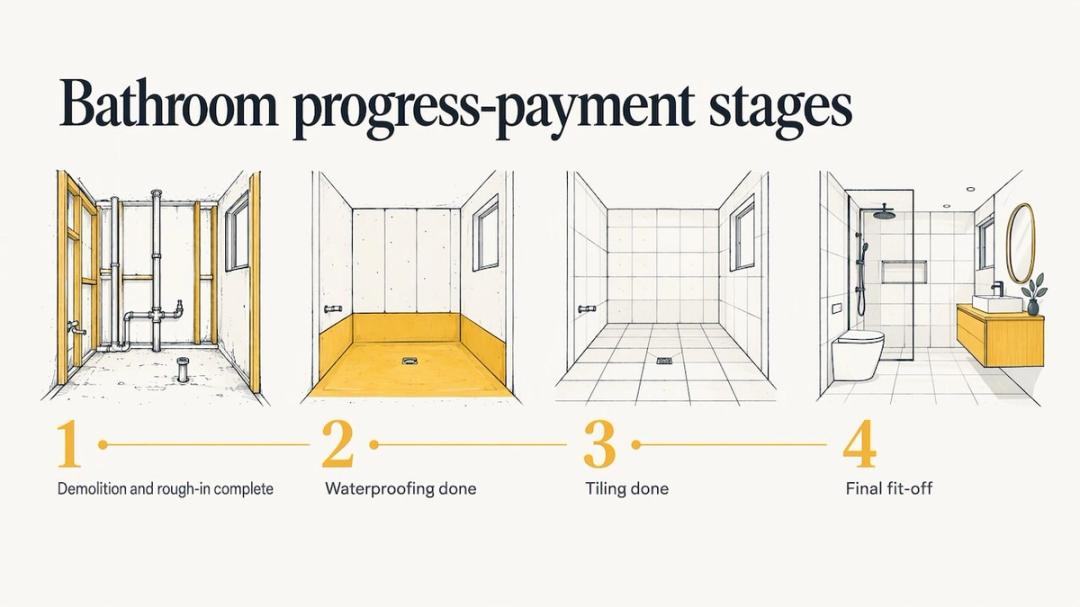
The QBCC recommends linking progress payments to clearly defined construction stages that you can inspect, with claims that relate directly to site progress and are proportionate to the value of work done. For a bathroom, sensible stages are demolition and rough-in complete, waterproofing done, tiling done and final fit-off. Never pay for a stage that has not happened.
Variations in writing
Changes are normal in renovations. Building Commission NSW says variations must be agreed in writing before the work is carried out. In Queensland, a variation document must describe the change, state the price adjustment or how it is calculated, say when it is payable or credited and include any estimated delay, and you approve it in writing before that work starts.
Defects and warranties
In Victoria, implied warranties apply by law and cannot be signed away: work must be done with due care and skill, in line with laws and plans, using suitable materials. Even a verbal service contract carries a guarantee of due care and skill, fitness for any specified purpose and completion within a reasonable time when no time is set. A written contract is still far easier to rely on if something goes wrong.
Why bathroom budgets drift, and how to plan for it
Bathrooms hide problems. Waterproofing, old plumbing and wiring are only visible once the room is stripped.
An industry annual report puts hidden costs at 10 to 25% of most Australian renovation budgets, with the top three causes being waterproofing failures found mid-job, electrical code upgrades triggered by the renovation and plumbing relocations. It suggests adding 15 to 25% to a quote for a realistic total spend. A separate budgeting guide recommends a 10 to 20% contingency on top of the builder’s quote and lists costs that sit outside it, such as council approval fees ($500 to $3,000 or more), architect or draftsman fees ($3,000 to $15,000 or more) and site inspections and certifications ($500 to $2,000). If you cannot use the room while the work is on, the same guide puts temporary accommodation at $2,000 to $10,000 a month, which matters more for a whole-home job than for a second bathroom.
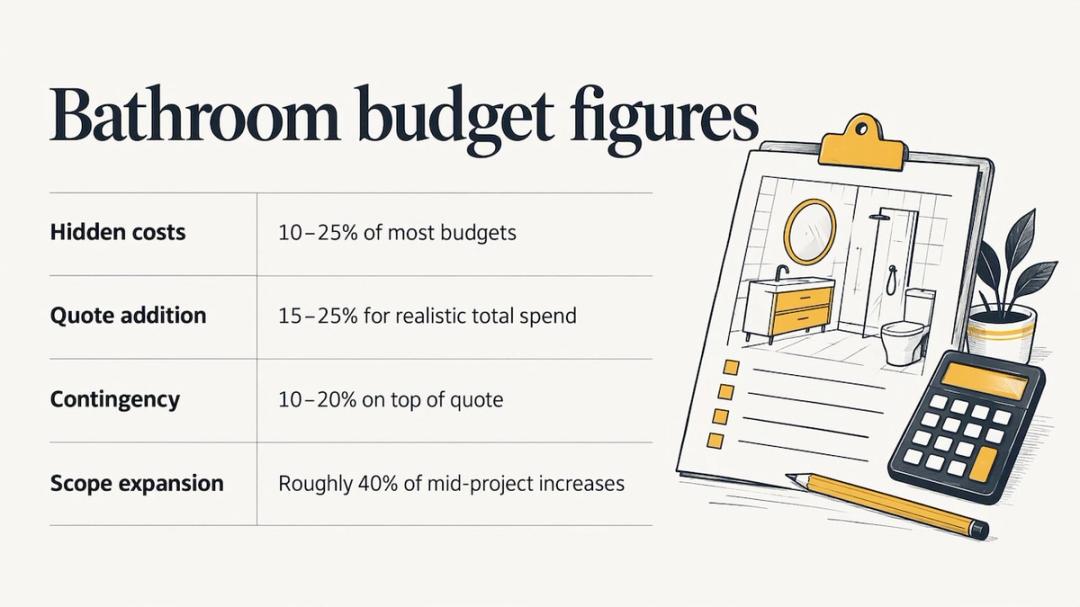
The same WTD report finds that the biggest predictor of final cost is scope, not city, tradie or brand. Scope expansion during demolition accounts for roughly 40% of mid-project cost increases. Decide whether you are doing a cosmetic update or a mid-range renovation before you ask for quotes, and stick to it. “While we’re in there” is the most expensive phrase in renovating.
A step-by-step way to hire
- Decide the scope and budget, including a contingency of 10 to 20% or more.
- Write the brief with room dimensions, layout changes, fixtures and finishes.
- Shortlist three licensed builders and verify licence, ABN and insurance.
- Collect written quotes from all three against the same brief.
- Normalise the quotes with the comparison grid: inclusions, exclusions, PC items, provisional sums.
- Call references and ask who supervises on site.
- Sign a written contract with stage payments, dates, a variations process and defect handling.
- Approve every change in writing before it is built.
FAQ
Do I need a licensed builder for a bathroom renovation?
Usually yes, but it depends on your state and the job value. In NSW, most residential building or trade work over $5,000 must be done by a licensed contractor, and bathroom renovation work requires the relevant licence or certificate. Check your state regulator’s register before you sign.
How many quotes should I get?
At least three, in writing, all based on the same plans and specifications. The NSW, Victorian, Queensland and Western Australian guidance all point to comparing several written quotes rather than relying on the lowest price.
What is the difference between a prime-cost item and a provisional sum?
A prime-cost item is an allowance for something you have not selected yet, such as taps, tiles or a vanity. A provisional sum is an estimate for work that cannot be priced exactly at signing, such as repairs revealed during demolition. Both can change the final price, so have them listed and compared.
How much deposit should I pay?
It depends on your state. Consumer Protection WA advises paying no more than 10% (or 6.5% for building matters) in Western Australia. Ask your state’s consumer or building regulator for the current limit, and link later payments to completed stages.
Is the same process right for a kitchen renovation?
Yes. Verify the licence, insurance and references, send every contractor the same brief and compare line items. For kitchens, pay special attention to supply-only versus supply-and-install quotes and to who handles appliances, plumbing and electrical.
Sources
- Step by step guide to choosing the right tradesperson or builder, NSW Government
- Getting quotes for building and renovating, Consumer Affairs Victoria
- About builders, tradespeople and other building practitioners, Consumer Affairs Victoria
- Implied warranties and domestic building insurance, Consumer Affairs Victoria
- Building contract protections, Building Commission NSW
- Kitchen, bathroom and laundry renovation work, NSW Government
- Getting quotes for contractors, NSW Government
- Guide to providing home building contracts, NSW Government
- Homeowner’s Guide to Building and Renovating, QBCC
- Domestic building contracts, QBCC
- Ask us: Estimates and quotes, Consumer Protection WA
- Questions to ask a bathroom renovator
- How to compare renovation quotes
- Kitchen quote checklist: inclusions, exclusions and hidden costs
- What kitchen renovation quotes leave out
- How to budget for a home renovation in Australia
- State of the Australian Renovation Market 2026, WTD Annual Report
- Provisional sums in building contracts, Australia