
Choose a real estate agent by meeting at least three, checking each one's licence, and comparing them on local sales evidence, marketing plan, fees and the written agreement. Don't pick the one who quotes the highest price or the lowest commission. Pick the one whose evidence, communication and terms hold up when you put them side by side.
This guide shows you how to do that, in order. It covers what to check before the first meeting, what to ask in it, how to read an appraisal, what an agency agreement must say, and what changes if you are a buyer or an investor rather than a seller.
TL;DR
- Speak with at least three agents, and check each licence with your state or territory regulator before you share anything private.
- Judge local knowledge by recent comparable sales, not by confident talk or a big name on a sign.
- Ask for commission, advertising and other costs in writing, and ask whether advertising is included in the fee.
- Read the agency agreement carefully. In Victoria there is no cooling-off period once you sign a sales authority.
- Buyers and investors need a different kind of professional, such as a buyers' agent, and a different set of questions.
Table of Contents
- Start with what you need the agent to do
- Check the licence and compliance record first
- Compare agents on the evidence, not the pitch
- Run the appraisal meeting like an interview
- Understand the fee and the marketing plan
- Read the agency agreement before you sign
- Spot the good signs and the warning signs
- A worked example: choosing between three agents
- If you are a buyer or an investor
- Compare agents side by side with Real Estate Hive
- Your step-by-step checklist
- FAQ
- Sources
Start with what you need the agent to do
Before you compare anyone, write down what a good result looks like for you. A seller who wants the highest price over six weeks needs something different from an owner who must settle by a fixed date. An investor selling a tenanted unit needs someone who understands that buyer pool. A first-home seller upgrading to a bigger place may care most about a smooth sale that lines up with a purchase.
Three questions sharpen the brief:
- What is my timeframe? A hard deadline changes the marketing approach and the campaign length.
- What is unusual about my property? A heritage house, a unit in a large complex, acreage or a renovated period home each suits agents who have sold that type.
- How involved do I want to be? Some owners want weekly calls. Others want a short update after each open home.
With that written down, you can judge agents against your needs rather than their sales pitch.
Check the licence and compliance record first
Every state and territory regulates agents, and checking takes a few minutes. In New South Wales, NSW Fair Trading advises speaking with at least three agents, checking each holds a current licence through the online check or by calling 13 32 20, asking about compliance issues the same way, and checking for professional indemnity insurance.
For NSW agents, the official NSW licence verification portal is the place to look up licence and registration details. NSW also publishes enforcement outcomes such as fines, suspensions and cancellations in a searchable list of property rule breakers, which is worth a look before you sign with anyone.
If you are in another state, use your state or territory's consumer or fair trading regulator, which runs its own licence register. The steps are the same: confirm the person you are dealing with is licensed, and confirm the agency is too.
Compare agents on the evidence, not the pitch
The fastest way to separate agents is to ask for facts you can check.
Recent sales in your street and suburb
Ask each agent for comparable sales: similar properties, sold recently, close to yours. A good agent explains why each comparison is relevant and what made one sell above or below the others. If an agent can't name sales near you, that tells you how much local work they do.
WA Consumer Protection notes that you can usually get a fair indication of local knowledge from factors such as where the office is, how much they advertise locally and how many of their For Sale signs you see in the neighbourhood.
Specialisation and type of property
Some agents handle mostly family homes. Others work on apartments, rural land or investment stock. Ask how many properties like yours they have sold in the past year, and who the likely buyers were. The answer shows whether they know where your buyer is coming from.
See them in action
The same WA guidance suggests assessing suitability by attending other open homes to watch an agent at work or by asking for a free market appraisal. Watch how they greet visitors, answer awkward questions and follow up. You are hiring this person to represent you in front of buyers.

Using a comparison directory
Side-by-side profiles save time when you are starting out, because you can see agents active in your area, their specialisations and reviews in one place. Our directory of real estate agents is built for that first shortlist. Treat it as the start of your checking, then verify the licence and ask for comparable sales in person.
Run the appraisal meeting like an interview
Book at least three appraisals, ideally on different days, and ask each agent the same questions so the answers are comparable. Consumer Affairs Victoria suggests discussing local market knowledge, comparable sales, the marketing plan, estimated selling price, commission and advertising costs with each agent, and asking for written quotes.
Questions worth asking every agent
- Which recent sales are the best comparisons for my property, and why?
- How did those properties sell: auction, private treaty or another method? How long were they on the market?
- What price range do you suggest, and what is it based on?
- What marketing do you recommend for my property, and what does each part cost?
- Who will actually run my campaign, you or a junior team member?
- How often will you update me, and by what means?
- What is your commission, and what is and isn't included?
- Have you had any compliance issues, and what insurance do you hold?
A market appraisal is not a valuation
WA Consumer Protection explains that an appraisal is what the agent considers the current market price, and it is not a valuation by a licensed valuer for a fee. That is why several appraisals are useful: they are opinions, and the reasoning behind each one matters more than the number.
Don't pick the highest estimate
Consumer Affairs Victoria specifically warns against choosing an agent just because they give the highest estimated selling price. An inflated estimate can win the listing and then lead to price cuts, a longer campaign and a weaker negotiating position. Ask each agent to show the sales that justify the figure. If one estimate sits far above the rest, ask why in plain terms.
In NSW the agreement itself must include the estimated selling price, so the number you hear in the meeting ends up on paper.
Understand the fee and the marketing plan
Commission is only part of the cost. Advertising, photography, signage and other outgoings can add up, and they are handled differently from agent to agent.
WA Consumer Protection advises asking whether the selling fee includes advertising and marketing costs. If the costs are separate, ask for the maximum amount that can be charged, where it is set out in the Written Authority, and an itemised list of the advertising types. NSW Fair Trading also says to ask for printed fee, commission and expense lists and compare them before you sign.
A simple comparison table keeps this honest. Fill one in for each agent:
| What to compare | Agent A | Agent B | Agent C |
|---|---|---|---|
| Commission (as a percentage or flat amount) | |||
| Is advertising included? | |||
| Maximum advertising spend | |||
| Recommended sale method | |||
| Suggested price range and the sales behind it | |||
| Who runs the campaign day to day | |||
| Contract length and exclusivity |
The lowest total cost is not automatically the best deal. A cheaper commission with a thin marketing plan can cost more in the final price than a stronger campaign. What you want is a fee that matches a clear plan, with every cost visible.
Judge the marketing plan on specifics
NSW Fair Trading lists examples of how an agent may promote a property, including online listings, open homes, letterbox drops and newspaper ads. A good plan explains which channels reach your likely buyer and why. A plan that is the same for every property is a template, not a strategy.
Presentation is part of that plan too. Agents often suggest small improvements before photos are taken, and some owners look at plantation shutters before selling as one way to lift how rooms look. Ask each agent which changes they believe would pay off for your home, and what they have seen work on comparable sales.
Read the agency agreement before you sign
The agreement is where the conversation becomes a contract, so slow down here. WA Consumer Protection advises that you compare fees and service quality with several agents, much like getting several tradesperson quotes, read the written agreement carefully, and remember that fees and services can be negotiated.
In NSW, an agency agreement for the sale of property must state the services the agent will provide, the fees or commission, and when commission is payable. It also covers how and when payment is made, including whether the agent can deduct commission from deposit money. The agreement must carry warnings about situations where you might owe commission to more than one agent, and about terms where commission could be payable even if the sale is not completed. NSW Fair Trading also says you should sign a written agreement before the agent can advertise or promote your property.
Points to check in any state
- Services: what exactly the agent will do, and what is extra.
- Fees: the commission amount and every other charge.
- When commission is payable: usually on sale, but check the exact wording.
- Exclusivity and duration: how long you are tied to this agent, and how you can end the arrangement.
- Other agents: whether you could owe more than one commission.
- Advertising budget: a stated cap, not an open-ended amount.
Don't sign to be polite
Consumer Affairs Victoria says not to sign anything, including a sales authority, unless you are prepared to engage that agent, and that there is no cooling-off period after signing a sales authority. Take the document home, read it, and ask questions before you commit. Rules differ by state, so check your own regulator's guidance.
Spot the good signs and the warning signs
After two or three meetings, patterns appear. Use this list to sort what you saw.
Good signs
- Comparable sales are specific, recent and close to your property.
- The agent explains the price range and welcomes your questions about it.
- The marketing plan is itemised and tailored to your buyer.
- Fees are written down and the agent doesn't rush you.
- The licence checks out and the agent answers compliance questions openly.
Warning signs
- An estimate far above the others, with little evidence behind it.
- Pressure to sign at the first meeting.
- Vague answers about advertising costs.
- A promise of a specific result.
- You are introduced to someone senior and then handed to someone else once you sign.
Communication counts for more than people expect. A seller is in regular contact with an agent for weeks. If the agent is slow to reply before you have signed, expect the same afterwards.
A worked example: choosing between three agents
Imagine you are selling a three-bedroom house in a suburb where you've seen several signs from two agencies and one smaller local office.
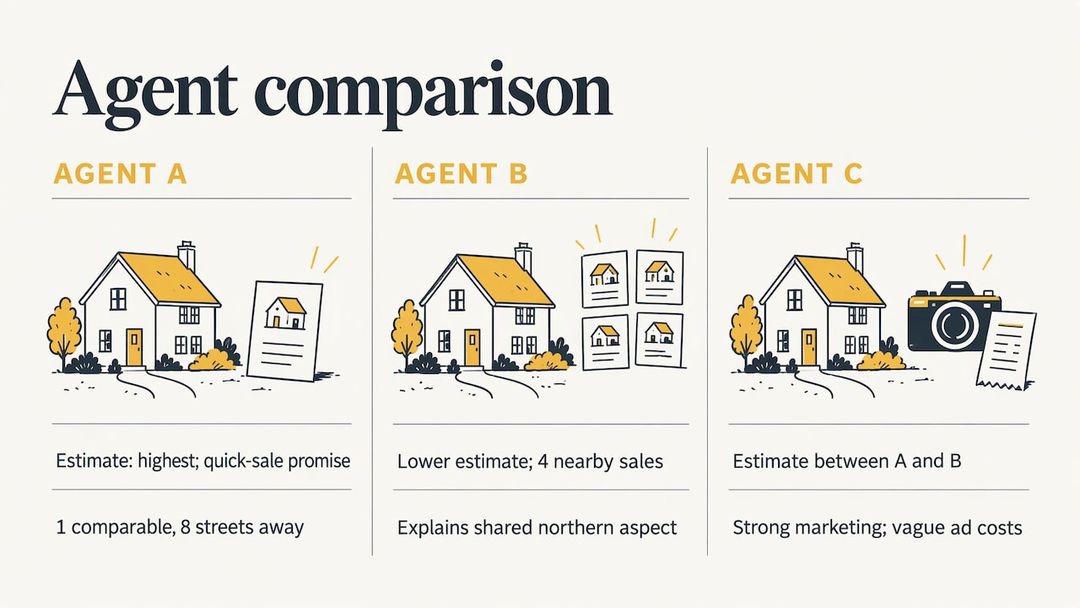
Agent A suggests the highest range and promises a quick sale, but cites only one comparable, from eight streets away. Agent B suggests a lower range backed by four sales within a few streets, and explains one that sold well because of a northern aspect your house also has. Agent C is between the two, with strong marketing but a vague answer about advertising costs.
On evidence, Agent B is the strongest. You'd still ask B for the commission and advertising costs in writing, ask A and C to justify their numbers, and check all three licences. If C then provides an itemised budget with a cap, C moves back into contention. The decision comes from the written comparison, not from who was most charming in the lounge room.
If you are a buyer or an investor
The agent who sells a property acts for the seller. If you are buying, a different professional works for you: a buyers' agent, who searches, assesses and negotiates on your behalf. The same logic applies. Compare several, confirm each holds a real estate licence in your state, ask about their recent purchases in your target area, and get their fees in writing before you engage.
For buyers and investors, useful questions include:
- Which suburbs and property types do you buy in most often?
- How do you find properties, including those not widely advertised?
- How are you paid, and is the fee fixed or tied to the purchase price?
- How do you handle conflicts of interest, such as relationships with selling agents?
- Can you describe a recent purchase similar to what I want, and what the outcome was?
Investors should add questions about rental demand, vacancy and the property management side. Our guide to what services management fees include explains how to read those costs. If you are searching in a major city, you can browse buyers' agents in Sydney, Melbourne, Brisbane, Perth or Adelaide.
If you are overseas, or buying for someone who is, our page on international real estate agents is a place to start.
Compare agents side by side with Real Estate Hive
Choosing well means collecting the same facts from several professionals and lining them up. That is what Real Estate Hive is designed for. Our directory lets you compare real estate agents, buyers' agents, mortgage brokers, tax experts, builders and other property professionals through detailed profiles, reviews and side-by-side comparison, so you don't have to search across multiple sites.
Start on the real estate agents page to build your shortlist, or explore everything on Real Estate Hive if you also need a mortgage broker, a builder or tax advice for the same property move.
Your step-by-step checklist
- Write down your goal, timeframe and what is unusual about your property.
- Shortlist at least three agents who are active in your suburb.
- Verify each licence with your state or territory regulator, and ask about compliance history.
- Attend an open home run by each agent, if you can.
- Book appraisals and ask every agent the same questions.
- Ask for comparable sales, a marketing plan, and fees and advertising costs in writing.
- Compare in a table. Question any estimate that is far above the rest.
- Read the agency agreement at home. Check services, commission, duration and exclusivity.
- Sign only with the agent you are ready to engage.
FAQ
How many real estate agents should I talk to?
At least three. NSW Fair Trading recommends speaking with at least three agents before you choose. That gives you enough to compare appraisals, fees and marketing plans without turning the process into a burden.
Should I choose the agent with the lowest commission?
Not on commission alone. Compare the commission together with advertising costs, services and the evidence behind the suggested price. Ask whether advertising is included in the fee, and get every cost in writing so the totals are comparable.
Is a free appraisal the same as a valuation?
No. An appraisal is the agent's view of the likely market price. A valuation is carried out by a licensed valuer, usually for a fee. Use appraisals to compare agents, and ask a valuer if you need a formal figure.
Can I change my mind after signing an agency agreement?
Don't count on it. In Victoria, Consumer Affairs Victoria says there is no cooling-off period after signing a sales authority. Read the agreement first, and check your own state's rules and the term and exit conditions before signing.
How do I choose a buyers' agent?
Use the same approach as for a selling agent. Compare several, confirm each is licensed, ask about recent purchases in your target area and how they are paid, and get the fee in writing before engaging.
Sources
- Selling property with or without an agent, Consumer Affairs Victoria
- Real estate fees and negotiating with an agent, WA Consumer Protection
- Using an agent or selling privately, NSW Government
- Agency agreements for the sale of property in NSW
- Verify licence, NSW property licensing
- NSW to name and shame property rule breakers