
The right commercial real estate agent depends on which side of the deal you are on. A selling or leasing agent works for the vendor or landlord. A commercial buyers agent works for you as the purchaser or tenant. If you are buying or leasing a shop, office, warehouse or investment property, you want someone whose duty is to you, and you can compare buyers agents and agents by city, profile and reviews on Real Estate Hive before you speak to anyone.
This guide explains the two roles, what a buyers agent does on a commercial purchase, how fees are structured, the rules that apply in Australia, and what to check before you sign an agreement.
TL;DR
- A commercial selling or leasing agent is engaged by the vendor or landlord and represents their interests. A buyers agent is engaged and paid by you.
- A commercial buyers agent can search on- and off-market, assess value using yields and comparable sales, negotiate, and see the purchase through to settlement.
- Commissions are agreed between you and the agent, not set by government. Get the fee basis, GST treatment and what triggers payment in writing.
- Rules differ by state. In Queensland, a commercial agent must be properly appointed on Form 6A (from 1 May 2024) before acting for a client.
- Shortlist two or three agents and compare them side by side before you commit.
Table of Contents
- Two agents, two clients
- What a commercial buyers agent does
- Why due diligence should be tailored
- How commercial agent fees work
- Rules that apply to commercial agents
- How to choose a commercial agent
- Compare commercial agents in one place
- Questions to ask before you sign
- FAQ
- Sources
Two agents, two clients
When people search for a "commercial real estate agent", they usually mean one of two very different people.
The selling or leasing agent. This agent is engaged by the owner to sell or lease a property. According to Commercial Property Guide, the selling agent represents the vendor, while the buyers agent is there for the buyer. Their job is to achieve a strong price and good terms for the owner. They are often knowledgeable and helpful to deal with, but the person who pays them is not you.
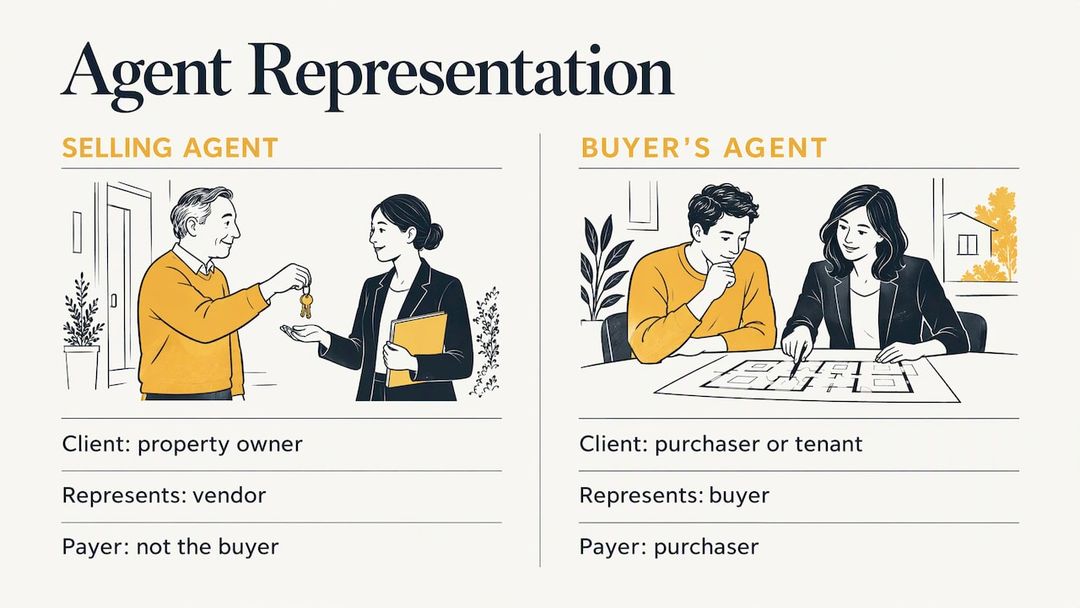
The buyers agent. A buyers agent acts for a purchaser or tenant. The REIQ Best Practice Guidelines describe buyers agents as licensed real estate professionals appointed to locate property, provide advice and facilitate a purchase for a person or entity. Commercial Property Guide notes that buyers agents are paid by purchasers and do not share in the selling agent's commission.
If you are a business owner buying premises, an investor adding a retail or industrial asset, or a self-managed super fund trustee looking at a commercial property, the second role is the one that puts a professional on your side of the table.
Which one do you need?
| Your situation | Who you want |
|---|---|
| Selling an office, shop or warehouse you own | A commercial selling agent |
| Leasing out a property you own | A commercial leasing agent |
| Buying commercial property | A commercial buyers agent |
| Leasing premises as a tenant | A buyers (tenant) agent who negotiates for you |
Commercial Property Guide also reports that buyer-side advocacy extends to commercial lease negotiations for tenants, which matters if your biggest cost will be rent rather than a purchase price.
What a commercial buyers agent does
Commercial purchases are priced and assessed differently from houses. Value is driven by rental income, lease terms, yield and the condition of the building, not by the look of the home.
According to REIWA, a buyers agent can:
- research on- and off-market properties against your budget and goals, looking at location, lease, future potential and practical features of the property;
- tailor due diligence and liaise with authorities;
- assess value using yields, cost per square metre and comparable sales;
- advise on an offer, negotiate, and help carry the purchase through to settlement.
The NSW Government's guide to using a real estate agent lists similar services: finding and shortlisting properties, researching a fair price, inspections, negotiation, auction bidding and following the transaction through to finalisation. That guide covers property buying generally, but the same scope applies on the commercial side.
A worked example
Say you are looking at a small industrial unit advertised with a rental income. Yield is the annual rent divided by the price. If the unit is listed at $1,000,000 and the tenant pays $65,000 a year, the gross yield is 6.5%. A buyers agent will compare that figure with recent sales and rents for similar units nearby, check how long the lease runs and what the outgoings are, and tell you whether the asking price is reasonable. That analysis is what the selling agent has no reason to give you.
Why due diligence should be tailored
A shop with a long lease to a national tenant raises different questions from a vacant warehouse you plan to fit out. REIWA's guidance points to due diligence being tailored to the property and your objectives rather than run as a generic checklist.
Typical questions to settle before you exchange or go unconditional include:
- Lease. Term, options to renew, rent reviews, who pays outgoings, and whether the tenant is stable.
- Zoning and permitted use. Can your business, or your tenant's, legally operate there?
- Building condition. Structure, services and compliance work you will inherit.
- Hazardous materials. Older buildings can contain asbestos, which affects your costs and your negotiating position. An asbestos inspection before exchange gives you something concrete to negotiate on.
- Finance and structure. Commercial lending, SMSF borrowing and tax treatment all change what you can afford. Your accountant and a mortgage broker should see the numbers early.
A good buyers agent coordinates these checks and keeps the timetable moving, so the contract conditions do not run out while you are still waiting for reports.
How commercial agent fees work
There is no single price list. Fees depend on the type of agent, the size of the deal and what you ask them to do, so treat any figure quoted in a general article as a starting point for your own quotes, not a benchmark.
Selling agents. The vendor and agent agree the commission, and it is usually calculated as a percentage of the sale price and paid at settlement. For leasing, the fee is commonly based on the rent over the lease term. You are the buyer, so you do not normally pay this directly, but it is built into how the seller prices the property.
Buyers agents. You engage and pay them. Typical structures include:
- an engagement or retainer fee at the start, then a success fee when you buy;
- a percentage of the purchase price;
- a fixed fee agreed for the scope of work;
- an hourly or project fee for narrower jobs, such as negotiating a lease.
What affects the total: the price of the asset, how hard the search is, whether you want help with off-market opportunities, and whether auction bidding or lease negotiation is included.
What to put in writing
- The fee basis and whether GST applies.
- What is payable up front and what is payable only on a successful purchase.
- What happens if the deal falls through or you buy a property the agent did not find.
- How long the agreement runs, and how you can end it.
- Whether the agent receives any payment from a vendor or selling agent. Ask for this to be stated.
Compare at least two or three written quotes on the same scope. A lower headline fee that leaves out due diligence or negotiation is not the cheaper option.
Rules that apply to commercial agents
Agent regulation in Australia is set by each state and territory, so check the rules where the property is.
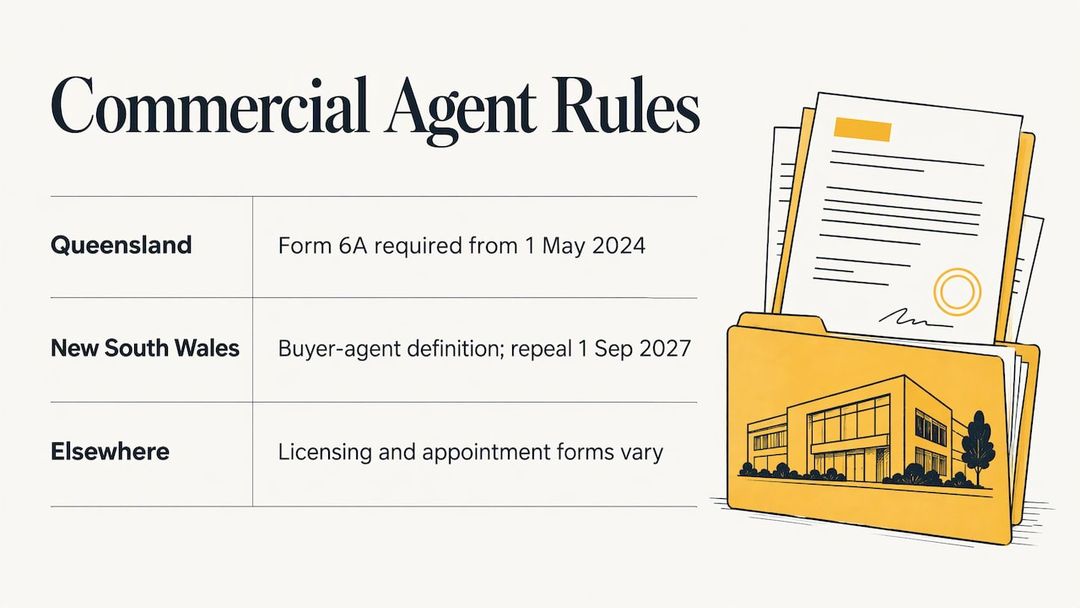
Queensland. The Queensland Government states that, from 1 May 2024, a commercial property agent and client must complete Form 6A for a valid appointment. A commercial agent cannot represent a client unless properly appointed. The state's forms dataset, updated in 2026, lists Form 6A as a distinct commercial form. If you are engaging an agent in Queensland, ask to see the completed form before work starts.
New South Wales. The Property and Stock Agents Regulation 2022 identifies a buyers agent as a real estate agent acting for a buyer or prospective buyer of land. It also covers assistant agents acting for a buyer within the limits of the Act and Regulation. The version in force from 1 July 2025 is scheduled for automatic repeal on 1 September 2027, so check the legislation site for the version that applies when you engage.
Elsewhere. Licensing requirements and appointment forms vary. Ask any agent for their licence details and confirm them with the relevant state or territory fair trading or licensing body.
How to choose a commercial agent
Use the same criteria whether you are comparing selling agents (to list your property) or buyers agents (to find one):
- Role clarity. Do they act for you? If you are buying, a buyers agent should.
- Asset experience. Have they handled the type you want: retail, office, industrial, medical, mixed use?
- Local knowledge. Recent sales, rents and vacancy in the specific suburb or precinct.
- Licence and appointment. Current licence and the correct appointment paperwork for your state.
- Fees. A written quote on a clear scope.
- Reviews and track record. Look for detail about the type of deal, not only star ratings.
- Communication. Who will you actually deal with, and how often will they update you?
Speaking to several agents is normal. It is the quickest way to see who understands your numbers and your plans.
Compare commercial agents in one place
Searching agent by agent means reading many websites that all say similar things. Real Estate Hive is an Australian property services directory where you can compare real estate agents, buyers agents, mortgage brokers, tax experts and other property professionals side by side, with detailed profiles and reviews in one place.

If you are buying, start with buyers agents and filter by city: Sydney, Melbourne, Brisbane, Perth, Adelaide and Canberra all have their own pages. If you are selling or leasing, see real estate agents. Funding the purchase through a self-managed super fund? The directory also lists SMSF loan specialists, and mortgage brokers and tax experts are there too, so you can line up your whole team.
Questions to ask before you sign
Whatever shortlist you build, take these to each first conversation:
- Who do you act for in this transaction, and will you confirm that in writing?
- How is your fee calculated, and what is included?
- What commercial deals like mine have you completed in this area recently?
- Which state licence do you hold, and what appointment form applies?
- What due diligence will you coordinate, and who are the specialists you work with?
- How do you find off-market opportunities?
An agent who answers these directly and in writing is easier to trust with a large purchase.
FAQ
What does a commercial real estate agent do?
A commercial selling or leasing agent markets a shop, office, industrial or other non-residential property for its owner and negotiates the sale or lease. They represent the vendor or landlord. A buyers agent does the equivalent work for the purchaser or tenant.
Is a commercial buyers agent worth using?
A buyers agent searches the market, assesses value using yields and comparable sales, negotiates and helps manage the purchase to settlement. That is useful when you are buying an asset where the numbers and the lease decide the outcome. Compare a few profiles and quotes to find the right fit for your deal.
How much do commercial buyers agents and commercial agents charge?
Commissions and fees are agreed between you and the agent rather than set by government. Buyers agents commonly use a retainer plus success fee, a percentage of the price, or a fixed fee. Get the basis, GST treatment and payment triggers in writing, and compare quotes on the same scope.
Do commercial agents need a special appointment in Queensland?
Yes. Since 1 May 2024, a commercial property agent and client in Queensland must complete Form 6A for a valid appointment. Ask to see it before you give any instructions.
How do I check commercial real estate agent reviews?
Read reviews that describe the type of property and the outcome, not only the rating. Look at several agents on one directory so the profiles are comparable, then ask each for recent examples of similar deals.
Sources
- Commercial Buyer's Agents: Here to Help, Commercial Property Guide
- How a buyers agent can help you buy a commercial property, REIWA
- Using a real estate agent to buy a property, NSW Government
- REIQ Best Practice Guidelines
- Commercial agent appointment (Form 6A), Queensland Government
- OFT property transaction forms, Queensland Government
- Property and Stock Agents Regulation 2022, NSW Legislation
- Asbestos inspection before exchange