
Most Australian buyers and sellers pay a conveyancer a professional fee of roughly $900 to $2,500, plus another few hundred dollars (or in some states a few thousand) in searches, settlement and registration charges that are passed on at cost. The professional fee is the part you can shop around. The disbursements are largely set by governments and the settlement platform. Compare quotes on the total, and ask each conveyancer to split it into those two parts.
This guide gives you the 2026 fee ranges by state, a worked example on an $800,000 purchase, the charges that catch people out and the questions to ask before you sign an engagement letter.
TL;DR
- Standard professional fees run from about $700 to $1,600 in WA, SA and TAS, up to $1,800 to $3,000 in the ACT, with NSW at $1,000 to $2,500 and Victoria at $900 to $1,500 to buy (Your Property Guide, 2026).
- Disbursements (searches, certificates, the PEXA settlement fee and registry fees) are charged on top, and on an $800,000 purchase they can range from $463 in NSW to over $3,000 in Queensland.
- No government body sets conveyancing fees, so the same job can be quoted very differently. Ask what is included, what costs extra and how extras are calculated.
- Compare the all-in total, not the headline fee. A lower base fee with extras charged separately can cost more.
- Conveyancing is only one line in your buying budget. Stamp duty, loan costs and inspections are separate.
Table of Contents
- What conveyancer fees cover
- Conveyancer fees by state and territory in 2026
- Disbursements: the costs on top of the fee
- A worked example: an $800,000 purchase
- Why quotes differ so much
- Solicitor or conveyancer?
- How to compare conveyancing quotes
- What buyers and sellers should budget for
- Costs that are not conveyancing fees
- Build the rest of your property team
- FAQ
- Sources
What conveyancer fees cover
Conveyancing is the legal and administrative work of transferring a property from seller to buyer: reviewing the contract, checking the title and council records, adjusting rates and other outgoings between the parties, and managing settlement. In most states a licensed conveyancer or a solicitor can do it. Queensland is the exception: conveyancers are not licensed there, so the work is done by law firms (Your Property Guide). In Western Australia the equivalent role is a settlement agent.
A conveyancer's role also includes explaining your rights and the contract terms, your cooling-off and withdrawal rights, and, in South Australia, reviewing the Form 1 vendor's statement and preparing the settlement statement that reconciles rates, taxes and levies (AICSA).
A fixed professional fee usually covers an agreed scope: contract review, exchange, dealing with the other side and settlement. Title and council searches, the settlement platform fee and registration are usually extra. Identity checks and additional contract reviews depend on the firm (Nestpath, October 2026).
Conveyancer fees by state and territory in 2026
The table shows standard professional fees, GST included and before disbursements, from a 2026 fee guide.
| State or territory | Buying | Selling |
|---|---|---|
| NSW | $1,000 to $2,500 | $1,000 to $2,500 |
| VIC | $900 to $1,500 | $800 to $1,300 |
| QLD | $885 to $2,600 | $619 to $1,600 |
| WA, SA, TAS | $700 to $1,600 | $700 to $1,600 |
| ACT | $1,800 to $3,000 | $1,800 to $3,000 |
| NT | $1,490 to $2,680 | $1,490 to $2,580 |
Source: Your Property Guide, Conveyancing Fees 2026, based on April to September 2026 fee guides.
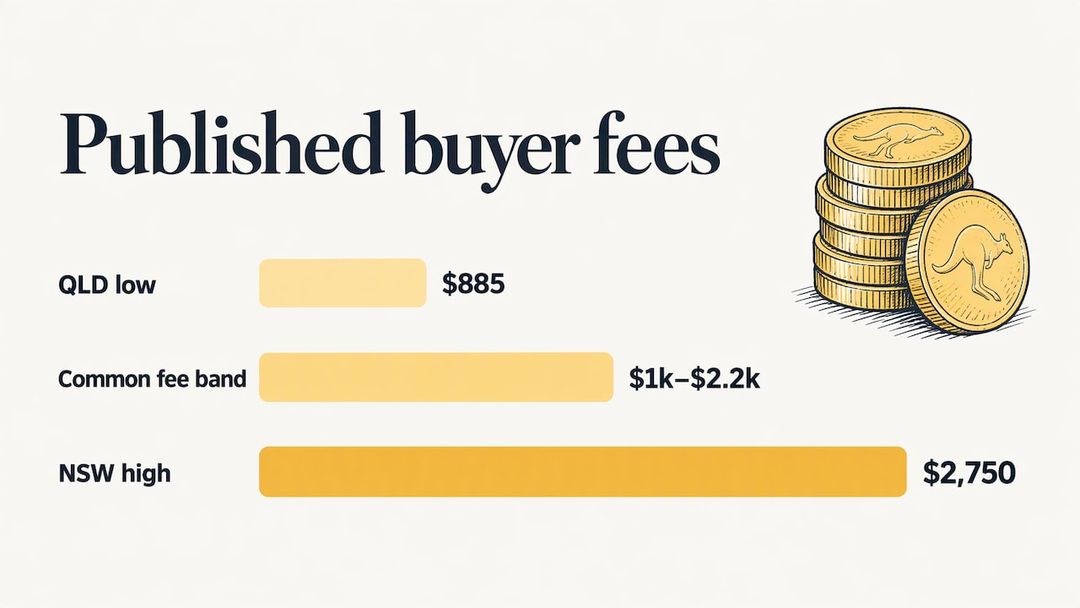
A separate October 2026 survey of 44 fee schedules from 35 firms found standard buyer fees ran from $885 in Queensland to $2,750 in NSW, with most published fees between $1,000 and $2,200 (Nestpath). If you want a single planning figure, $1,000 to $2,200 is a sensible band for a straightforward purchase, with the ACT and parts of NSW and the NT sitting higher.
Two things to know about these numbers. They are published ranges, not guarantees, and your own quote will depend on the property and the firm. And in NSW there is no prescribed conveyancing fee, so the market sets the price (RS Law Group).
Disbursements: the costs on top of the fee
Disbursements are the third-party costs your conveyancer pays on your behalf and bills back to you. NSW Fair Trading's guidance says buyers are usually charged them on top of professional fees, including title searches, authority certificate fees, photocopying, mortgage registration and transfer registration. It also advises asking for an itemised statement of likely costs before work starts (NSW Government).
The main items are:
- Title and council searches. These confirm who owns the property and what the council records say about it.
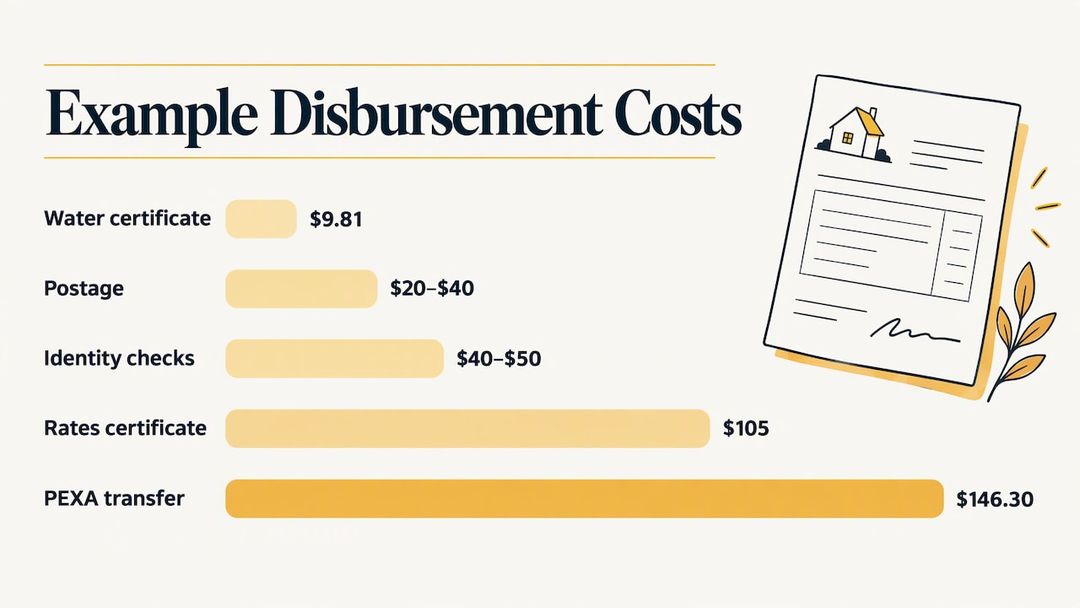
- Water and rates certificates. For example, Sydney Water's conveyancing certificate is $9.81 from 1 July 2026 to 30 June 2027, and City of Sydney's outstanding rates certificate is $105 (Nestpath).
- The PEXA settlement fee. PEXA is the online platform on which most settlements are lodged. Its single-title transfer fee is $146.30 including GST in NSW. From 1 October 2026 in Queensland it charges $147.40 for a primary participant and $146.30 for an additional participant (Nestpath).
- Registry fees. These are charged by the state land registry to record the transfer and any mortgage.
- Identity verification and postage. One guide puts identity checks at $40 to $50 and postage at $20 to $40 (Conveyancing.com.au).
PEXA fees are scheduled to rise twice in 2026: a new Industry Data Standard charge from 18 May and a CPI-linked increase of about 4.1% from 1 July. They are typically passed on to you in the conveyancer's account (Bushletter). Because these amounts move each financial year, ask your conveyancer for the figure that applies to your settlement date.
A worked example: an $800,000 purchase
Disbursements vary far more between states than professional fees do. One 2026 guide calculates that, on an $800,000 purchase, searches, the PEXA fee and the registry's transfer fee (from 1 July 2026) add $463 in NSW, $2,273 to $2,408 in Victoria and $3,497 to $3,757 in Queensland. In Queensland the registry fee rises with the property price (Your Property Guide).
To see the effect, assume a professional fee of $1,500 including GST. This is an illustration, not a quote:
| NSW | VIC | QLD | |
|---|---|---|---|
| Professional fee (assumed) | $1,500 | $1,500 | $1,500 |
| Disbursements, $800,000 purchase | $463 | $2,273 to $2,408 | $3,497 to $3,757 |
| Total | $1,963 | $3,773 to $3,908 | $4,997 to $5,257 |
The same fee produces a very different bill depending on the state. That is why a friend's "it only cost me $1,200" tells you little: check whether they were quoting the fee alone or the full cost.
Why quotes differ so much
Nobody regulates what conveyancers charge. AICSA, the professional body for conveyancers in South Australia, says it does not set or regulate member fees and that the government does not either. Fees reflect each conveyancer's professionalism and the complexity of the transaction, and a conveyancer may charge extra for unforeseen additional work (AICSA).
The main drivers of price are:
- Complexity. Off-the-plan purchases cost more than a standard resale.
- Property type and value. Apartments need strata searches, and higher-value or commercial properties may use sliding-scale fees.
- Your role. Sellers often pay more because the contract has to be prepared.
- Location. NSW metro fees are higher than regional ones, and the NT's higher averages reflect remote-area factors (Conveyancing.com.au).
- Who does the work. Online conveyancers can charge 10 to 20% less than traditional practices, but may not suit complex deals.
That last point matters. An online service suits a straightforward house purchase. If your deal involves easements, caveats, an off-the-plan contract or a trust structure, you want a practice that can handle it.
Solicitor or conveyancer?
For a standard purchase or sale, a licensed conveyancer is usually enough, and in Queensland a law firm does the job anyway. A guide to 2026 fees recommends a solicitor rather than a conveyancer for trust or SMSF purchases, complex joint ownership or a likely contract dispute (Your Property Guide). If you plan to buy through a self-managed super fund, a solicitor is the right professional to see for the legal side, and you can compare SMSF loan specialists separately for the finance.
Buyers and sellers each need their own conveyancer. Engage yours before you make an offer or bid, so the contract and the vendor disclosure (the Section 32 statement in Victoria, with equivalents elsewhere) can be read before you are bound.
How to compare conveyancing quotes
Headline numbers mislead. One NSW firm's advice is to avoid comparing them until you know what each covers, and to think of total cost as a fixed professional fee plus applicable disbursements plus any agreed additional work (Coutts Legal). Use this routine.
- Ask for written quotes from at least two providers. Request that each one separates the professional fee from disbursements (Jameson Law).
- Ask what is included. Does the fee cover contract review, a second review if you change the contract, identity checks, settlement and the settlement platform fee?
- Ask what attracts extra fees and how they are calculated. This is the question AICSA recommends.
- Check whether the fee is fixed or sliding-scale. In NSW, fixed fees for buyers usually include all searches and disbursements, whereas a sliding-scale rate charges some costs separately. A lower base amount can be harder to budget and may cost more overall (RS Law Group).
- Watch for vague wording. Phrases such as "miscellaneous fees" or "search costs to be confirmed" are a signal to ask for numbers.
- Test responsiveness. One firm suggests a reply taking longer than 48 hours points to a stretched practice, and you should confirm the conveyancer carries professional indemnity insurance (Jameson Law).
A South Australian practitioner puts the goal well: not the cheapest quote but the lowest total risk at a fair price. Urgency costs money too. Last-minute changes and tight settlement timeframes drive up buyers' costs, while late vendor disclosure or slow mortgage discharge drive up sellers' costs (NSA Conveyancing).
What buyers and sellers should budget for
If you are buying, budget for the professional fee, the contract review, searches, electronic settlement costs and lender coordination, plus strata or community title extras if you are buying an apartment or townhouse.
If you are selling, budget for contract or disclosure preparation, mortgage discharge coordination, searches, settlement charges and adjustments for rates, water and strata contributions. In NSW a sale contract must be prepared before a residential property is offered for sale, so you carry legal costs before the property is advertised (RS Law Group). Factor that in before you choose an agent, and our guide on how to choose a real estate agent covers the other half of your selling costs.
Costs that are not conveyancing fees
Buyers often blame the conveyancer for charges that belong to someone else. The NSW Government lists other costs around a purchase: building and pest inspections, survey reports, mortgage establishment, home building insurance, valuation fees, lenders mortgage insurance, stamp duty and mortgage duty, strata levies, council and water rates and outstanding land tax (NSW Government). Stamp duty in particular is a state tax calculated on the purchase price, not a conveyancing fee, and it is usually the biggest single item. Our guide on how to calculate stamp duty walks through it.
If you are investing, your deposit and loan structure shape the budget as much as legal fees do. See what influences deposit amounts for investment properties.
Build the rest of your property team
A conveyancer handles the legal transfer. The decisions that move your money most sit elsewhere: the loan, the price you pay and the tax position of the purchase. Real Estate Hive is an Australian directory where you can compare mortgage brokers, buyers' agents, real estate agents and tax experts side by side, using detailed profiles and reviews rather than searching across multiple sites.
If you are buying in a major city, you can start with buyers' agents in Sydney, Melbourne or Adelaide, or browse the whole directory from the Real Estate Hive home page. Line up your finance and your adviser before you go to contract, so your conveyancer is reviewing a deal you have already priced properly.
FAQ
How much does a conveyancer cost in Australia?
For a standard residential purchase or sale, professional fees mostly fall between about $900 and $2,500 depending on the state, with the ACT and NT at the higher end (Your Property Guide). Disbursements are charged on top. A typical total is the fee plus a few hundred dollars in NSW, and considerably more in Victoria and Queensland on higher-priced properties.
How much do conveyancers charge in South Australia?
One 2025 guide gives an average professional fee of $1,270 in SA, within a range of $700 to $1,600, with disbursements of $250 to $500 (Conveyancing.com.au). A survey of three SA firms found published buying fees of $1,045 to $1,859 (Nestpath). Buyers also budget for Form 1 review, and sellers for Form 1 preparation.
Is it better to use a solicitor or a conveyancer?
A licensed conveyancer is usually enough for a straightforward sale or purchase, and Queensland transactions go through law firms in any case. Use a solicitor for trust or SMSF purchases, complex joint ownership or any deal likely to end in a contract dispute.
Do both the buyer and the seller pay a conveyancer?
Yes. Each party engages and pays their own conveyancer. Sellers often pay somewhat more because the contract has to be prepared, and one guide puts typical buyer costs at $800 to $2,000 and seller costs at $900 to $2,200 (Conveyancing.com.au).
Will conveyancing fees change?
Professional fees are set by each firm, but the PEXA and council charges inside the total change on a financial-year cycle, with PEXA increases scheduled during 2026 (Bushletter). Ask for an itemised quote dated close to your exchange so the figures are current.
Sources
- Your Property Guide: Conveyancing Fees 2026
- Nestpath: Conveyancing Fees Australia by State (October 2026)
- NSW Government: Conveyancing for property buyers and sellers
- AICSA: Consult a Conveyancer
- Conveyancing.com.au: How Much Does Conveyancing Cost in Australia
- Bushletter: PEXA grilled in NSW as competition deadline nears
- RS Law Group: How Much Does Conveyancing Cost in NSW?
- Coutts Legal: Conveyancer Cost NSW
- Jameson Law: Conveyancing Quotes NSW
- NSA Conveyancing: Conveyancing Costs in South Australia