

Refinancing a home loan means replacing your current mortgage with a new one, either with your existing lender or a different one, to get a better rate, better features or access to equity. It pays off when the savings clearly beat the costs of switching, and the quickest way to test that is to line up your current loan against several options at once. A mortgage broker can do that comparison and manage the paperwork, and on Real Estate Hive you can compare mortgage brokers side by side, with detailed profiles and reviews, before you choose one.
This guide is for Australians who already have a home loan: first-home buyers a couple of years in, investors reviewing a portfolio, and homeowners who want to fund a renovation or tidy up their debts.
TL;DR
- Refinancing swaps your existing mortgage for a new one, with your current lender or a new one, and it can lower your rate, change your features or release equity.
- It makes sense when the savings outweigh the costs: discharge, application and settlement fees, and any fixed-rate break costs.
- The process has five steps: review your loan, compare options, work out costs and borrowing power, apply, then settle. Allow a few weeks in total.
- A licensed mortgage broker can compare lenders, explain costs and manage the application. Check how they are paid before you sign.
- Compare brokers in your city on Real Estate Hive before you commit.
Table of Contents
- What refinancing a home loan actually means
- When to refinance a mortgage
- How to refinance a home loan: five steps
- What refinancing costs
- Using a mortgage broker to refinance
- Find a mortgage broker for your refinance
- Refinancing for different goals
- Before you sign: a short checklist
- FAQ
- Sources
What refinancing a home loan actually means
When you refinance, you take out a new mortgage and use it to pay off the old one. Moneysmart, the government's money guidance service, describes it as switching your home loan from one lender to another. You can also refinance with your current lender by moving to a different loan product they offer. Either way, the old loan is closed and a new contract starts, with its own rate, fees, features and term.
People refinance for a handful of reasons:
- A lower interest rate or lower fees. The most common reason, because even a small rate difference compounds over a long loan.
- Lower or different repayments. A new term or structure can change what you pay each month.
- Equity access. If your property has gained value or you have paid down the loan, you may be able to borrow against that equity, for example for a renovation.
- Fixing repayments. Some borrowers move to a fixed rate to lock in certainty.
- Consolidating debts. Several loans can be rolled into one, a benefit lenders commonly list.
- New features. Offset accounts and redraw facilities may be on offer that your current loan lacks.
Notice that a lower rate is only one reason. A refinance can be worth it for structure and features alone, and it can also go wrong if you chase a headline rate and ignore everything around it.
When to refinance a mortgage
There is no single date that suits everyone, but a few situations are good prompts to look again.
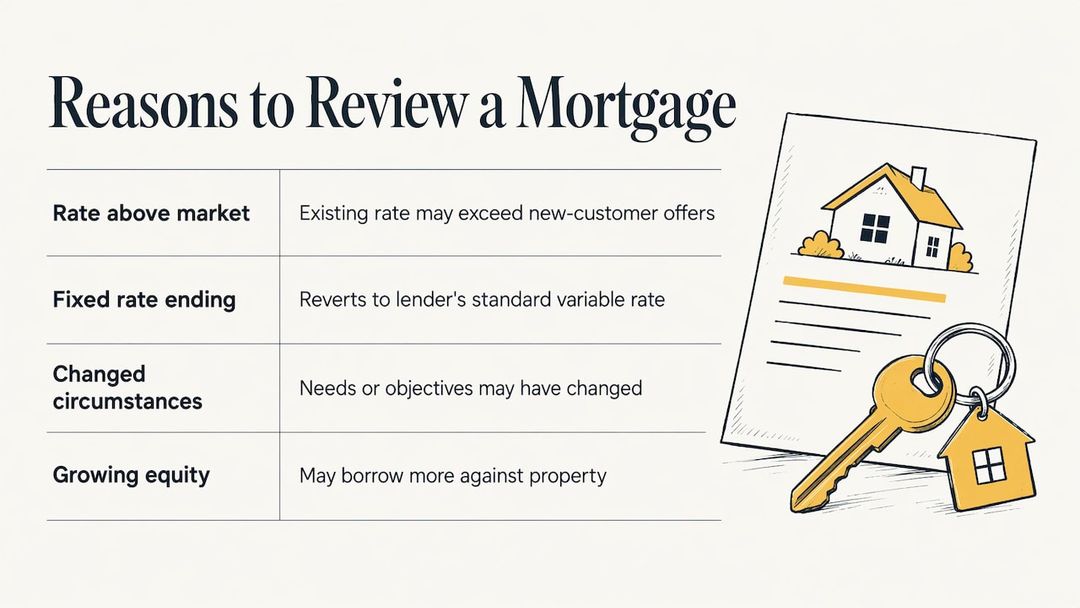
Your rate has drifted above the market. Lenders price new borrowers competitively and existing customers do not always see the same rate. If you have not compared options for a while, you may be paying more than you need to. Rates move with the Reserve Bank of Australia's cash rate decisions and with each lender's own pricing, so check live comparison tables rather than relying on any figure printed in an article.
Your introductory or fixed rate is ending. Moneysmart advises asking what happens when a fixed or introductory rate ends. A introductory variable rate reverts to the lender's standard variable rate once the period finishes, and that is often a natural moment to reassess.
Your circumstances have changed. A pay rise, a new baby, an investment purchase or a renovation plan can all mean your current loan no longer fits. Lenders note that people usually look at refinancing when their situation, needs and objectives change.
Your equity has grown. If you want to renovate, you may be able to borrow more against the property. If a build is involved, our guide on whether a construction loan can help a renovation covers the alternative.
Don't refinance too soon
Timing matters in the other direction too. CommBank's guidance suggests waiting 12 to 24 months before refinancing, and notes that refinancing too soon could affect your credit score. Each new application also triggers a credit check, which could slightly alter your score.
A simple test: do the savings beat the costs?
Here is a worked example with made-up round numbers, to show the logic and not to predict your result. Say switching saves you $120 a month in repayments, and the switch costs $1,200 in total fees. You recover the cost in ten months ($1,200 divided by $120). If you plan to keep the loan for years, the switch looks sound. If a fixed-rate break cost of $4,000 sits on top, the payback stretches to more than three and a half years, and the answer depends on how long you will keep the property.
The maths is always the same: total switching costs divided by monthly saving gives your payback period. Compare it with how long you expect to hold the loan.
How to refinance a home loan: five steps
The steps below follow the five-step process lenders outline, with the points where people most often get stuck.
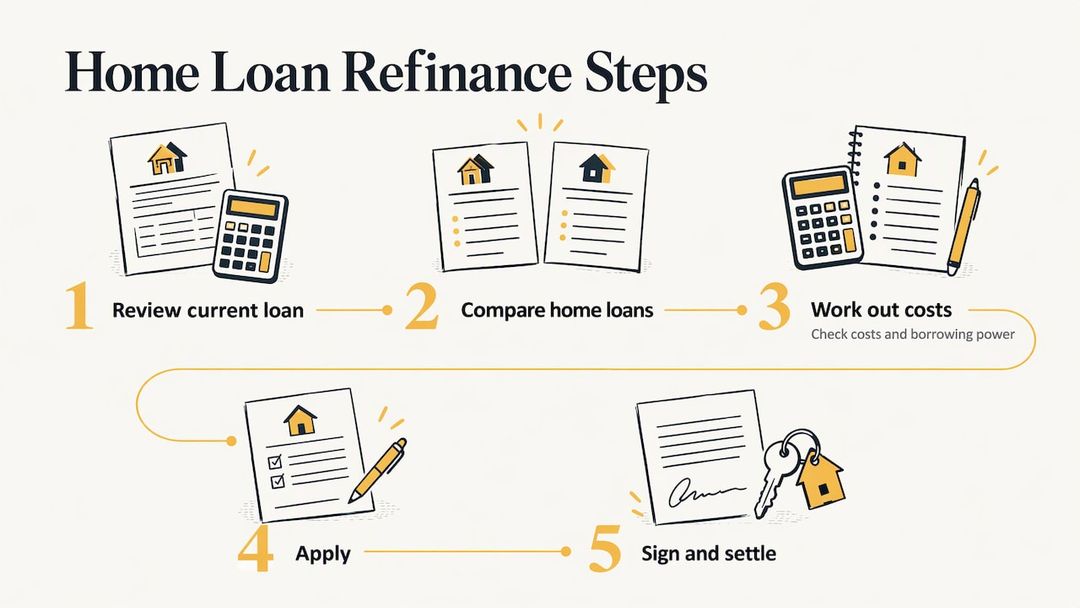
Step 1: Review your current loan
Pull out your latest loan statement and note four things: your interest rate, your outstanding balance, your remaining term and the features you use (offset, redraw, extra repayments). Also find out whether you are on a fixed rate and when it ends.
Where it goes wrong: borrowers compare only the rate and forget that they use an offset account worth hundreds of dollars a year in saved interest. A new loan without that feature can cost you more even at a lower rate.
Step 2: Compare home loans
Look at the interest rate, the comparison rate, fees, loan term and features. The comparison rate bundles most fees into a single annual figure, which makes loans easier to line up, though it does not capture every cost, so read the fee schedule as well.
Where it goes wrong: comparing across too few lenders, or comparing a new customer rate against your current rate without checking what that new rate reverts to. This is the step where a broker earns their place, because one conversation can cover many lenders. On Real Estate Hive, you can compare mortgage brokers by profile and reviews, and our listing shows real-time updates so you are not guessing who is taking enquiries.
Step 3: Work out the costs and your borrowing power
Add up what leaving your old loan and opening the new one will cost (see the next section), then check how much a lender would let you borrow. Your borrowing power depends on income, expenses, existing commitments and the lender's assessment of your property.
Where it goes wrong: assuming that because you are meeting repayments now, a new lender will approve you at the same level. Lenders assess you afresh, so a new car loan, a higher credit card limit or a change in employment can shift the answer.
Step 4: Apply
You will typically need identification, proof of income, current loan statements, and details of your expenses, assets and other financial commitments. The lender will usually also look at your repayment history and may arrange a property valuation. Required documents vary with your circumstances and the lender.
Where it goes wrong: missing documents and inconsistent figures cause most of the delays. Our article on common mortgage mistakes that delay loan approval lists the ones to avoid.
Step 5: Sign and settle
Once approved, you sign the loan contract. At settlement, the new loan pays off the old one. If you are switching lenders, you may need to complete a mortgage discharge authority, which authorises your old lender to release the mortgage over your property. Keep making your existing repayments until settlement is confirmed, so you do not fall behind during the changeover.
How long does it take?
As a guide, switching usually takes a few weeks: a few days to a couple of weeks to compare options, then 2 to 4 weeks for approval, and 1 to 2 weeks to settle and switch. Complicated applications, such as self-employed income or a property that needs a more detailed valuation, can take longer.
What refinancing costs
Costs fall into three groups: closing the old loan, opening the new one and carrying it over time. Lender guidance lists the main items:
| Cost | When it applies |
|---|---|
| Break costs | If you leave a fixed-rate loan before the fixed term ends |
| Discharge fee | Charged by your old lender to close the loan and release the mortgage |
| Application and settlement fees | Charged by the new lender to set up the loan |
| Government charges | Mortgage registration and related fees |
| Ongoing fees | Monthly or annual account fees, and fees for features such as offset or redraw |
| Lenders mortgage insurance (LMI) | May apply if the new loan is more than 80% of the lender's assessed value of the property |
Some published guides put the typical total at roughly $500 to $2,000, but your figure depends on your lender, your state and whether you are leaving a fixed rate, so get a written breakdown before you proceed.
Two cost traps deserve a closer look:
- Fixed-rate break costs. They can be large and are calculated using the lender's formula. Ask your current lender for an estimate before you decide. If you are moving into a fixed rate, there may also be limits on how much extra you can repay before you trigger break costs.
- LMI. If your property has not grown in value enough, or you want to borrow extra against it, a new loan above 80% of the assessed value can bring LMI back into the picture. Ask about this before you apply.
As a rule, make sure the costs do not outweigh the benefits, and ask about every fee that might apply, including any other fees or charges that could apply.
Using a mortgage broker to refinance
A broker is a licensed professional who compares loans from a panel of lenders on your behalf. According to Moneysmart, a broker can help you work out what you can afford to borrow, find suitable options, explain loan costs and features, and help manage your application through to settlement. For a refinance, that means one person doing the legwork of steps 2 to 5, while you keep control of the decision.
That is the strongest case for using a broker rather than going lender by lender: you see more options in one sitting, you get the fee and feature trade-offs explained, and someone else chases the paperwork. Our guide on whether to use a mortgage broker for your home loan walks through the reasoning in more detail.
What to check before you choose a broker
Moneysmart's guidance points to a short list:
- Licensing. Confirm the broker holds an Australian credit licence or represents a licensee.
- Lender panel. Ask which lenders they work with.
- Payment. Ask how they are paid. Lenders generally pay the broker a commission, and any fee you pay directly must be set out in a written quote you sign before they provide services.
- Fees. Ask what, if anything, you will pay.
There is also a protection on the commission side. As reported in June 2026, clawbacks of broker commission are prohibited beyond two years from the start of the credit contract, and for a refinance the clock starts the day after the refinanced credit is available. Our list of top questions to ask your mortgage broker covers what to raise on that first call.
Find a mortgage broker for your refinance
Real Estate Hive is an Australian property services directory. Instead of searching broker websites one by one, you can compare mortgage brokers side by side, read detailed profiles and reviews, and see real-time updates, all in one place. Our directory also lists SMSF loan and NDIS loan specialists if your situation is more specific, and tax experts if you want advice on the investment side of a refinance.

Start on the mortgage broker directory, or go straight to your city: Sydney, Melbourne, Brisbane or Hobart. Investors holding property through a self-managed super fund can look at SMSF loan specialists.
Refinancing for different goals
First-home buyers. Once you have built some equity and a repayment record, a review is worth doing. Compare your current rate with other lenders, and consider whether features like an offset account would suit you. Mind the 12 to 24 month guideline above.
Investors. Refinancing can restructure debt across properties, release equity for the next purchase or switch between interest-only and principal-and-interest repayments. Ask a tax professional how a change in loan structure affects your deductions before you sign. You can find tax experts through our directory.
Homeowners renovating. If your property has grown in value, you may be able to borrow against the equity to fund building work. Line up your loan plan before you commit to a builder, and compare builders at the same time so the budget and the finance match.
Before you sign: a short checklist
- You know your current rate, balance, remaining term and features.
- You have an estimate of break costs from your current lender if you are on a fixed rate.
- You have compared the comparison rate and the fee schedule, not just the headline rate.
- You have worked out your payback period against how long you will keep the loan.
- You have confirmed whether LMI could apply.
- You have collected your ID, income proof, loan statements and details of expenses, assets and commitments.
- If you use a broker, you have checked their licence, lender panel and how they are paid.
FAQ
Can I refinance with my current lender?
Yes. There are two routes: stay with your current lender or switch to a new one. Staying can mean fewer steps, but it is still worth comparing the wider market so you know whether the offer is competitive.
How long does it take to refinance a home loan?
Usually a few weeks from start to finish: comparing options, 2 to 4 weeks for approval and 1 to 2 weeks to settle. Missing documents are the most common cause of delay.
Is it worth using a mortgage broker to refinance?
A broker compares multiple lenders, explains the costs and features, and manages the application through to settlement. Moneysmart recommends checking their licence, lender panel and payment arrangements first. You can compare brokers by profile and reviews on Real Estate Hive.
What does it cost to refinance?
Costs can include discharge, application and settlement fees, government charges, ongoing fees, fixed-rate break costs and, in some cases, LMI. Ask both lenders for a written breakdown so you can compare total costs against your monthly saving.
Sources
- Switching home loans, Moneysmart
- Choosing a home loan, Moneysmart
- Using a mortgage broker, Moneysmart
- Should you refinance your home loan or switch lenders?
- How to refinance your home loan: key steps
- The costs of refinancing your home loan
- How to refinance a home loan, Westpac
- Refinance your home loan, CommBank
- What is home loan refinancing? Pepper Money
- No-Clawback Is a Best-Interest Question Now, The Broker Times