
A property depreciation schedule is a report that forecasts the tax deductions available on an investment property, usually over 40 years. It covers the building structure and the removable assets inside it. It is prepared by a quantity surveyor, it estimates deductions and not the property's sale value, and it is worth ordering once the property is genuinely available for rent. This guide explains what goes into one, who can claim, how the numbers are worked out, and how a schedule differs from a valuation report. It also covers how to line up the right professionals around it, from a tax expert to a mortgage broker.
TL;DR
- A depreciation schedule forecasts deductions for a rental property: capital works (the structure) and plant and equipment (the assets), typically over up to 40 years.
- The ATO accepts a quantity surveyor's estimate when construction costs are unknown. It says valuers, agents, accountants and solicitors generally lack the qualifications for that estimate.
- A schedule is not a valuation. A valuation assesses market value on a date, while a schedule projects tax deductions over time.
- Order it once the property is available for rent, and update it after major renovations.
- Work out how the deductions fit your tax position with a tax expert, and compare the professionals around your purchase in one place on Real Estate Hive.
Table of Contents
- What a property depreciation schedule is
- Capital works deductions (Division 43)
- Plant and equipment deductions (Division 40)
- Why a quantity surveyor prepares the schedule
- When to get a depreciation schedule
- How much a depreciation schedule costs
- Depreciation schedule versus property valuation report
- Who to line up around your investment property
- Find the right property professionals in one place
- Common mistakes with depreciation schedules
- FAQ
- Sources
What a property depreciation schedule is
Buildings wear out and fittings lose value. The tax system lets owners of income-producing property claim part of that decline as a deduction each year. A depreciation schedule is the document that works those deductions out in advance and sets them out year by year.
According to a quantity surveying firm's explanation of the report, it calculates the decline in value of the building structure and of the assets in it, with a forecast that typically runs up to 40 years. It is a forward-looking calculation of tax deductions. It is not a statement of what your property would sell for.
The ATO draws the line between two kinds of deduction in its rental properties guide:
- Division 43, capital works: eligible construction expenditure on buildings and structural improvements.
- Division 40, depreciating assets: the decline in value of assets, generally the removable or mechanical items.
A good schedule separates the two, because they follow different rules and different timelines.
Capital works deductions (Division 43)
Capital works cover the bricks-and-mortar side: walls, roof, floors, built-in cabinetry, and structural improvements such as driveways or retaining walls, where they qualify. The ATO says capital works deductions can generally be claimed for 40 years from completion of construction, subject to the construction and income-use details the ATO requires.
The ATO also states that land itself cannot be written off as a capital works deduction, and that Division 43 rates are generally 2.5% or 4.0% depending on when construction began and the type and use of the works.
A worked example makes the scale clear. If the construction cost of a building is $250,000 and the rate is 2.5%, the annual deduction is $6,250 ($250,000 × 0.025). The deduction is only available for the period the property is rented or genuinely available for rent, so a property that sits vacant by choice during part of the year does not qualify for that part.
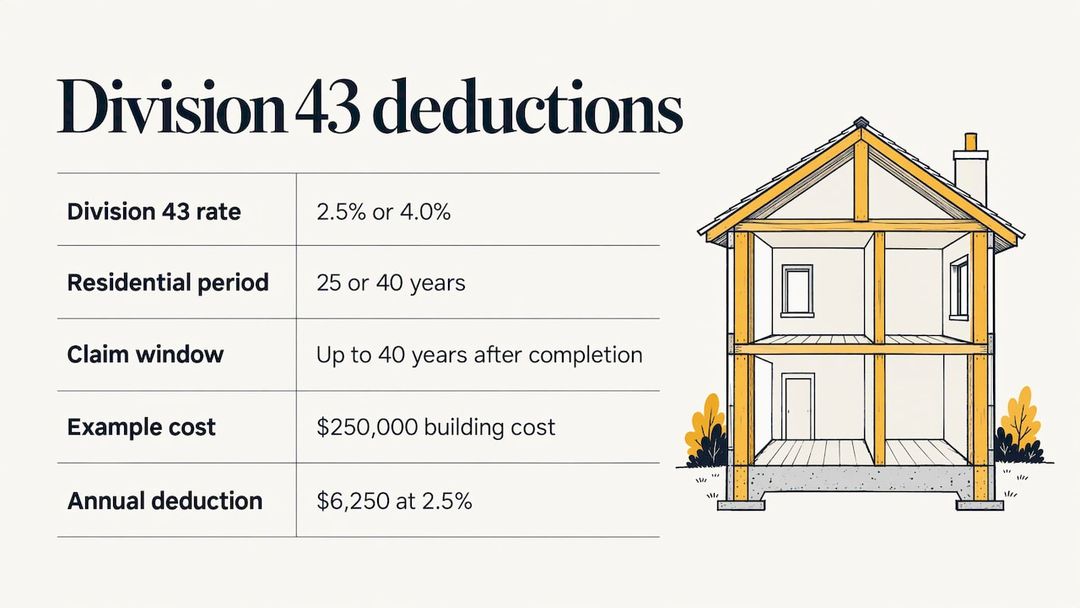
The ATO's rental guide notes that residential capital works deductions are generally spread over 25 or 40 years, depending on the applicable rules. Your schedule should state which applies to your building.
Plant and equipment deductions (Division 40)
Division 40 covers the assets inside the property: items such as carpets, blinds, hot water systems, ovens and air conditioners. The ATO lets investors choose between two methods for working out the decline in value:
| Method | How it works | When it suits |
|---|---|---|
| Diminishing value | Higher deductions in the early years, falling over time | Investors who want larger deductions sooner |
| Prime cost | A constant amount each year across the asset's effective life | Investors who prefer even, predictable deductions |
The same ATO page sets out two small-asset rules worth knowing:
- Assets costing $300 or less can often be claimed as an immediate deduction in the income year they are first used for a taxable purpose, with rules against splitting a set of items to get under the limit.
- Assets valued at less than $1,000 can be grouped into a low-value pool and depreciated together.
Which method you pick, and how second-hand assets in an established property are treated, depends on your circumstances. That is a question for a tax expert, not a guess. You can find and compare tax experts alongside the other property professionals in the Real Estate Hive directory.
Why a quantity surveyor prepares the schedule
Owners often ask whether their accountant, agent or valuer can simply estimate the construction cost. The ATO has addressed this. When a new owner cannot determine construction expenditure precisely, an estimate may be supplied by an appropriately qualified person such as a quantity surveyor. Unless they hold other qualifications, valuers, real estate agents, accountants and solicitors generally lack the relevant experience for that estimate.
The reasoning is simple. A depreciation report requires two things: estimating what the building cost to construct, and classifying each asset under the tax rules. A valuation is a different exercise, assessing market value under valuation standards. So the quantity surveyor is the specialist for the schedule, and the tax expert is the specialist for how it fits your return.
What the surveyor needs from you
The quantity surveyor typically inspects the property, then works from details you supply. According to the surveying firm's guidance, they may ask for:
- The settlement date
- The purchase price
- Details of any improvements
- The date the property became income producing
Have your contract of sale, settlement statement and any renovation invoices ready. If the property was built by a previous owner and records are thin, the surveyor's estimate fills the gap, which the ATO accepts where construction costs are unknown.
When to get a depreciation schedule
The sensible time is soon after the property is available for rent, ideally close to settlement. Schedules do not expire. The firm's guidance says one lasts for the life of the property, although significant changes, such as a major renovation, may mean it needs updating.
If you have already owned the property for a while, it is not too late. The same guidance says missed deductions can be claimed for at least two years after purchase, and you should confirm how amended returns apply to you with a tax expert.
If the property becomes income-producing part-way through a financial year, a schedule can include pro-rata figures for that first year, so you only claim for the time it was rented or available for rent.
A simple timeline for a new investor
- Before you buy: compare finance options and check your borrowing position with a mortgage broker, and consider using a buyers agent to shortlist and negotiate.
- At settlement: keep the contract, settlement statement and any building documents.
- When the property is ready to rent: arrange the quantity surveyor's inspection and report.
- At tax time: give the schedule to your tax expert so that deductions are applied correctly.
- After major works: have the schedule updated.
How much a depreciation schedule costs
The price depends on the property type, its size and complexity, and the surveyor's inspection requirements. Residential, commercial and rural properties are priced differently, and the fee is a deductible expense in its own right in many cases, which your tax expert can confirm.
If you want to see how people typically think about the sums, this breakdown of depreciation schedule costs puts the fee next to the deductions it can unlock. Request quotes for your specific property, and compare what each includes: whether the inspection is part of the price, how the 40-year forecast is presented, and whether the first-year pro-rata is calculated.
Depreciation schedule versus property valuation report
Searchers often mix up the two documents, so it is worth separating them clearly.
| Depreciation schedule | Valuation report | |
|---|---|---|
| Purpose | Forecast tax deductions | Assess market value on a date |
| Prepared by | Quantity surveyor | Valuer |
| Output | Year-by-year deductions, up to 40 years | A value, with the basis for it |
| Used for | Tax returns on an income-producing property | Finance, legal, tax and other purposes |
The Australian Property Institute's valuation protocol defines market value as the estimated amount for which an asset should exchange between a willing buyer and a willing seller in an arm's-length transaction, with knowledgeable, prudent parties and no compulsion. The same protocol identifies three approaches: market, income and cost. Where results differ, they should be reconciled rather than averaged.
A formal valuation also needs an inspection. The professional rules for valuers describe a valuation report as one prepared following a process that includes a physical inspection and the necessary enquiries. A desktop exercise without inspection produces only an indicative value.
Agent appraisal versus independent valuation
A real estate agent's appraisal is a different thing again. The Queensland Valuers Registration Board explains that an agent's appraisal is a broad estimate of likely sale price or rent, whereas a registered valuer's valuation is an independent assessment that can be relied on for financial decisions and for legal or statutory requirements. In Queensland, carrying out a legally relied-on real-property valuation without the required registration contravenes the Valuers Registration Act 1992.
For a seller or buyer wanting a feel for the market, an appraisal from a local agent is a sensible first step. You can compare agents' profiles and reviews on the real estate agents page before you invite anyone to inspect.
What valuations cost
Valuer fees vary with the property type, location, size, complexity, the purpose of the valuation, access and inspection requirements, and urgency. A standard home is generally cheaper than a complex or commercial property, and a rushed job costs more. Ask for a written quote that states the purpose and the inspection included. A valuation for a lender is arranged for the lender's purposes, so confirm with your broker what the bank requires before you pay for a separate one.
For buyers, a valuation is a check on price, while a depreciation schedule comes later, after you own the property and it is available to rent. They answer different questions at different stages.
Who to line up around your investment property
A depreciation schedule is one piece of the investment puzzle. Most investors end up working with several professionals:
- A mortgage broker to structure the loan, including options such as SMSF or other specialised lending.
- A buyers agent to search, assess and negotiate the purchase.
- A tax expert to apply the schedule's deductions to your return and advise on your personal tax position.
- A quantity surveyor for the schedule itself, since the ATO recognises that qualification for construction-cost estimates.
- A builder if you plan renovations, which can change the schedule.
Tax treatment depends on your individual circumstances, so confirm the deductions you claim with a registered tax professional before lodging.
Find the right property professionals in one place
Real Estate Hive is an Australian directory where you can compare real estate agents, buyers agents, mortgage brokers, tax experts, builders and other property professionals side by side, with detailed profiles, reviews and real-time availability updates. Instead of searching a dozen sites, you see the options together and choose the person who fits your purchase.

Start on the Real Estate Hive homepage to browse tax experts and mortgage brokers. You can also go straight to builders if renovations are on the cards. If you are buying in a capital city, the Sydney, Melbourne, Perth and Adelaide pages list local property experts.
Common mistakes with depreciation schedules
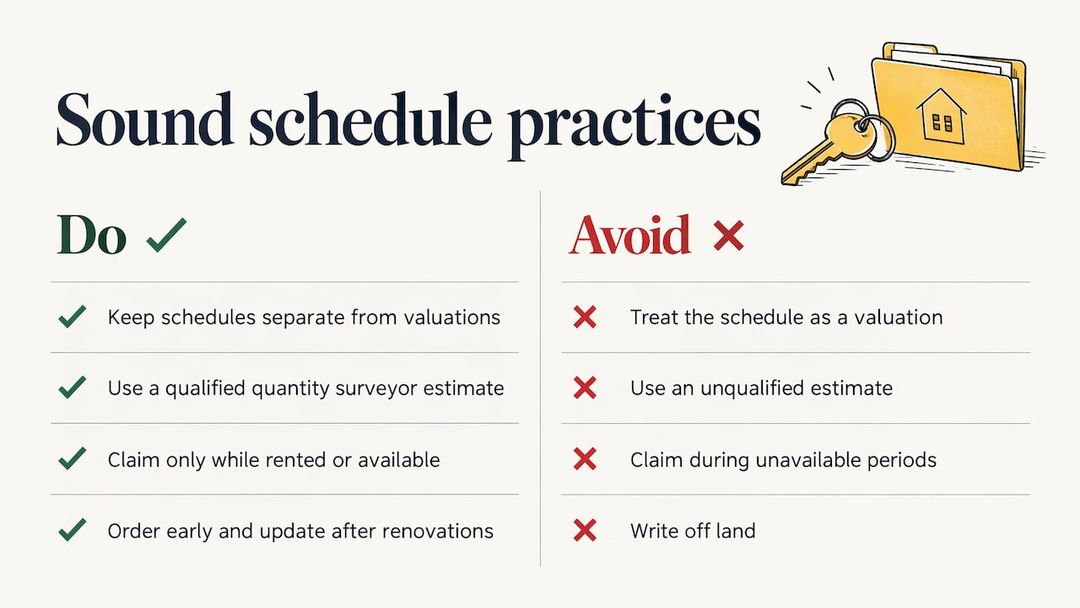
Treating it as a valuation. The schedule does not tell you what the property is worth. Keep the two documents and their purposes separate.
Using an unqualified estimate. When construction costs are unknown, the ATO accepts an estimate from a quantity surveyor or similar qualified person. It says valuers, agents, accountants and solicitors generally do not have the right qualifications for that.
Claiming for periods the property was not available for rent. Deductions apply only while the property is rented or genuinely available for rent.
Forgetting to update after renovations. A schedule lasts, but major changes may require an update so new items are captured.
Writing off land. Land is not depreciable under capital works.
Leaving it too late. Missed deductions can generally be claimed for at least two years after purchase, but ordering early means you claim from the first year.
FAQ
What is the depreciation schedule for a rental property in Australia?
It is a report that forecasts deductions for the building structure (capital works, generally over 25 or 40 years) and for assets inside the property (plant and equipment). Capital works rates are generally 2.5% or 4.0% depending on when construction began and the type and use of the works. Plant and equipment is claimed using the diminishing value or prime cost method.
Where can I get a depreciation schedule?
A quantity surveyor prepares it after inspecting your property. The ATO names quantity surveyors as the appropriately qualified people for construction-cost estimates. Once you have the report, a tax expert can apply it to your return, and you can compare tax experts on Real Estate Hive.
Is a depreciation schedule the same as a property valuation?
No. A valuation assesses market value on a particular date, prepared by a valuer who inspects the property. A depreciation schedule projects tax deductions over time and is prepared by a quantity surveyor. Lenders and government authorities accept formal valuations, not schedules, for value.
When should I order a depreciation schedule?
Order it once the property is genuinely available for rent, ideally soon after settlement. It does not expire, but you should update it after significant renovations. If the property starts earning income part-way through the year, the schedule can pro-rate the first year.
Can I claim depreciation on an old property?
Yes, in many cases. Capital works deductions depend on the construction date and use, and the ATO accepts a quantity surveyor's estimate when original costs are unknown. Because rules differ for second-hand assets and older buildings, confirm your position with a tax expert before you lodge.
Sources
- Depreciation Schedule, quantity surveying report guidance
- ATO Rental properties guide 2025
- ATO: Work out your capital works deductions
- ATO: Capital works deductions
- ATO: Depreciating assets in rental properties
- API Valuation Protocol: Valuation Approaches and Methods
- API Rules of Professional Conduct, effective 1 September 2024
- Queensland Valuers Registration Board: Valuation v appraisal