

Most full-service buyers agents in Australia charge between 2% and 3% of the purchase price plus GST, or a flat fee set by price bracket, plus an upfront engagement fee. That is the industry body's own description of the industry average for a full search, inspection, due diligence and negotiation service. On a $900,000 purchase, that is a very different bill depending on which structure you choose and what it covers. This guide lists the ten things that decide what you will pay, so you can compare agents on the same footing, whether you are buying a first home or an investment property.
TL;DR
- A common full-service range is 2% to 3% of the purchase price plus GST and an engagement fee, or a flat fee based on the price bracket.
- Fees are not set by law, so they can be negotiated, and the fee sits in a written agreement you should read before signing.
- Some fees can be payable even if you end the agreement or buy without the agent's help.
- A buyers agent's fee is not a tax deduction on an investment purchase, but it may form part of the property's cost base for capital gains tax.
- Compare agents on fee structure, scope, timing and licence, not on the headline number alone.
Table of Contents
- What you are actually comparing
- 1. Percentage fees
- 2. Flat fees
- 3. Hybrid and tiered fees
- 4. The engagement fee
- 5. The scope of service
- 6. Investment purchases
- 7. Location
- 8. Who pays, and when
- 9. The written agreement
- 10. Licence, insurance and rebates
- How to turn the ten points into a shortlist
- Compare buyers agents side by side
- FAQ
- Sources
What you are actually comparing
A buyers agent works for you, not the seller. They typically research suburbs, find properties (sometimes before they are advertised), inspect them, check the due diligence and negotiate or bid at auction. Consumer Affairs Victoria notes that an estate agent cannot act for both the buyer and the seller in the same transaction, which is why your agent's fee should come from you and nobody else.
The ten points below are ordered the way most buyers meet them: structure first, then what is included, then timing, then the fine print.
1. Percentage fees
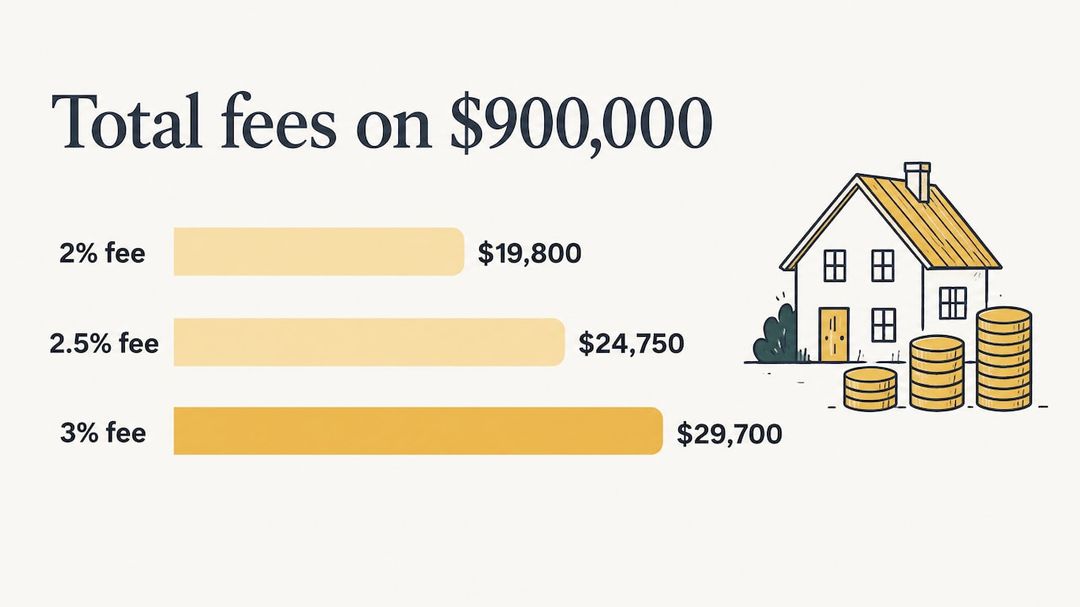
The traditional model charges a percentage of the final purchase price. The industry body puts the typical full-service range at 2% to 3% plus GST, with an engagement fee on top.
A worked example on a $900,000 purchase, using simple arithmetic:
| Fee rate | Fee before GST | GST (10%) | Total |
|---|---|---|---|
| 2% | $18,000 | $1,800 | $19,800 |
| 2.5% | $22,500 | $2,250 | $24,750 |
| 3% | $27,000 | $2,700 | $29,700 |
The percentage model scales with price. On a $600,000 unit at 2%, the fee is $12,000 before GST. On a $1.5 million house at the same rate, it is $30,000. If you are buying at the top of your budget, this is the structure where your cost grows fastest.
2. Flat fees
A flat fee is set in dollars, usually based on the purchase price bracket, and is also described by the industry body as a standard alternative to a percentage. The attraction is predictability: you know the total before the search begins, and the fee does not rise if the agent finds a property at the top of your range.
Ask how the brackets work. A flat fee for properties up to $800,000 will often be lower than for $800,001 to $1.2 million, so the price you realistically expect to pay decides which bracket you land in. If your budget straddles two brackets, ask what happens if you end up buying in the higher one.
3. Hybrid and tiered fees
Some agents combine the two: a smaller fixed retainer to start the search, then a success fee at settlement. Others use a tiered percentage, charging a higher rate on the first part of the price and a lower rate on the rest. These structures are agent-specific, so ask for the full calculation on your own budget rather than the rate alone.
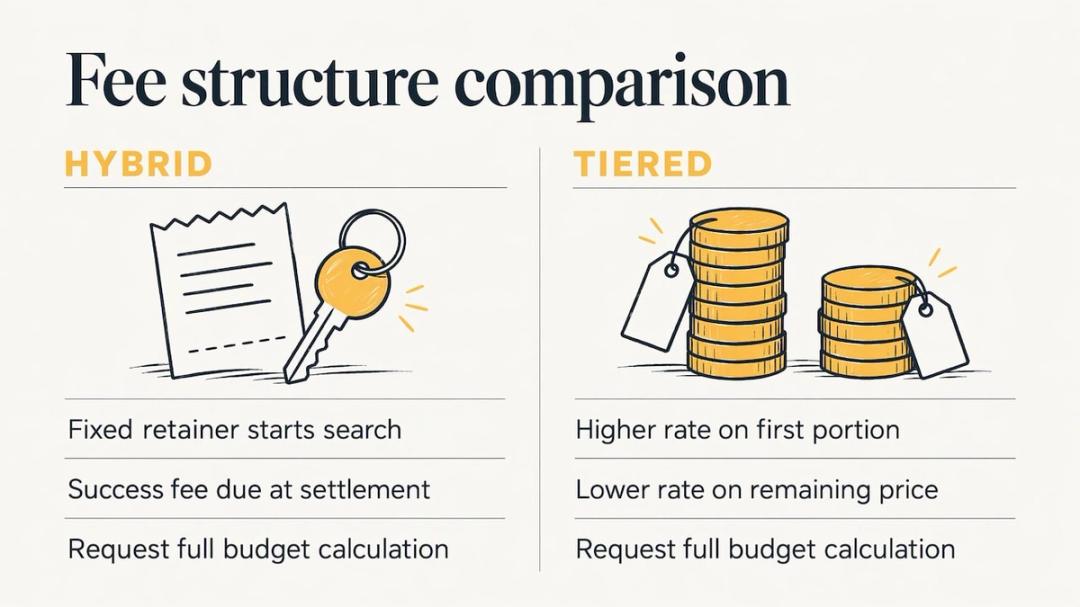
The practical test: put the same $900,000 purchase through each agent's structure and compare the total in dollars, including GST. That one number makes quotes comparable.
4. The engagement fee
Most agents ask for an engagement fee when you sign, to commission the search. The industry body lists it alongside the percentage or flat fee, not instead of it. Check two things:
- Whether the engagement fee is credited against the final fee or added on top.
- Whether any part of it is refundable if the agent does not find you a property.
These are exactly the points that belong in the written agreement, and a quote that is vague on them is a quote to clarify before you go further.
5. The scope of service
A full-service engagement typically covers strategy, research, sourcing, inspections, due diligence, negotiation or auction bidding and support through to settlement. Narrower services cost less: you might pay only for an agent to evaluate a property you have found, to negotiate on it, or to bid at an auction on the day.
If you are a first-home buyer who has already shortlisted properties, a narrower service may fit. If you are an interstate investor who cannot attend inspections, full service is usually what you are comparing. Decide which one you need before you collect quotes, because a full-service fee and an auction-bidding fee are not the same product.
6. Investment purchases
Investors often ask for a buyers agent with a specific brief: yield targets, growth areas, a particular property type, or a search across several states. That changes the comparison in three ways.
- Experience with your strategy. An agent who regularly buys the type of asset you want will find it faster than a generalist.
- Reach. A national search can involve travel and interstate research, so ask whether it is covered by the fee.
- Tax. The Australian Taxation Office says you cannot claim a deduction for the fees of a buyers agent engaged to find you a rental property to buy, but those costs may form part of the property's cost base for capital gains tax purposes. Keep the invoice and talk to a tax professional about how it fits your situation.
Finance matters just as much on an investment. If you are weighing structure, loan type and borrowing capacity at the same time, a mortgage broker can run the numbers while you shortlist agents.
7. Location
Fees tend to move with property prices, because percentage fees and bracketed flat fees both follow the price. A Sydney or Melbourne purchase will usually generate a larger percentage fee than the same rate in a lower-priced market. Agents also specialise by area, and local knowledge is often the whole value of the engagement.
So compare locally. If you are buying in a particular city, start with agents who work there:
- Buyers agents in Sydney
- Buyers agents in Melbourne
- Buyers agents in Brisbane
- Buyers agents in Perth
- Buyers agents in Adelaide
- Buyers agents in Canberra
- Buyers agents in Tasmania
- Buyers agents on the Gold Coast
- Buyers agents on the Sunshine Coast
8. Who pays, and when
You pay your buyers agent. In some structures part of the fee is due at engagement and the balance when the contract becomes unconditional or at settlement. Ask for the due dates in writing, and match them against your own cash flow, because the engagement fee comes out before you have a property and before you have drawn on a loan.
It is worth knowing that fees can follow you out of the agreement. Western Australia's Consumer Protection guide says some fees are payable even if you end the agreement or buy a property yourself without the agent's help. Read the termination clause before you sign, in any state.
Costs outside the agent's fee also need a place in your budget: building and pest inspections, valuations, a conveyancer, lender fees and stamp duty. Our guide to conveyancer fees covers one of the larger ones.
9. The written agreement
The fee lives in the agreement, so the agreement is where you compare. The same WA guide says a written contract is required and that, under the Australian Consumer Law, a single price quoted to you must include GST. That helps: ask for the total including GST and compare totals, not rates.
Consumer Affairs Victoria describes the buyer's agency authority as the legal document that sets out the fees, and says fees are not set by law and can be negotiated. Reasonable things to negotiate include the engagement fee, the bracket boundary, and a cap on the total.
Rules differ by state, so check your own state's fair trading or consumer protection body for the requirements that apply to you.
10. Licence, insurance and rebates
The cheapest quote is not a comparison if the agent is not properly licensed. Consumer Affairs Victoria recommends checking the agent's licence on the public register, asking about professional indemnity insurance, and asking about any rebates from third parties. Each state and territory keeps its own register, so search the one for the state you are buying in.
The rebate question matters because your agent's loyalty should be to you. If they receive a referral payment from a lender, builder or other business, you should know before you sign.
How to turn the ten points into a shortlist
Here is a routine that takes an evening:
- Decide your service: full search, evaluate and negotiate, or auction bidding only.
- Set your realistic price and ask each agent to quote on that figure, GST included.
- Ask each agent for the engagement fee, balance, due dates and what happens if you pull out.
- Check each licence on your state register and ask about insurance and rebates.
- Compare totals in dollars, not rates, and then compare experience in your suburb or strategy.
If you are a first-home buyer, add one question: how much will the agent explain along the way? If you are an investor, ask about their track record with your property type.
Compare buyers agents side by side
Realestatehive lists buyers agents across the major cities and regions, with detailed profiles, reviews and availability updates in one place, so you can compare several agents on the points above without searching site by site. Start with the buyers agents directory, or go straight to your city's page.
If you also need finance for the purchase, you can browse mortgage brokers in the same directory, including specialists in SMSF loans for investors buying through a self-managed super fund.
FAQ
How much does a buyers agent cost in Australia?
The industry body describes a typical full-service fee as 2% to 3% of the purchase price plus GST and an engagement fee, or a flat fee based on price. On a $900,000 purchase, 2% to 3% is $18,000 to $27,000 before GST. Narrower services, such as auction bidding only, cost less.
Can I claim a buyers agent fee as a tax deduction?
For a rental property you are buying, the ATO says you cannot claim a deduction for the buyers agent's fee, though it may form part of the property's cost base for capital gains tax. Ask your tax adviser how it applies to your circumstances.
Can I negotiate a buyers agent's fee?
Yes. Consumer Affairs Victoria states that fees are not set by law and can be negotiated. The engagement fee, bracket boundaries and any cap on the total are common points to raise before you sign the agreement.
Do I still pay if I end the agreement?
Possibly. Western Australia's Consumer Protection guide says some fees are payable even if you end the agreement or buy a property without the agent's help. Read the termination clause and ask for the amounts in writing.
Sources
- Real Estate Buyers Agents Association of Australia, FAQs
- Consumer Affairs Victoria, Seek expert advice on property
- WA Consumer Protection, Using a buyer's agent
- Australian Taxation Office, Rental expenses