

An investment property loan is a mortgage used to buy a property you will rent out rather than live in. Lenders assess it more strictly than an owner-occupier loan, so the deposit you hold, the way your income is counted and the loan structure you choose decide how much you can borrow. The surest route to approval is to understand those three things first, then compare mortgage brokers who work with investors. On Real Estate Hive you can compare mortgage brokers side by side, using their profiles and reviews, before you commit to a lender.
TL;DR
- Lenders commonly expect a deposit of around 20% of the purchase price, plus cash for stamp duty, legal fees and other upfront costs. A smaller deposit usually means Lenders Mortgage Insurance (LMI).
- Banks test your repayments at a rate well above the real one. APRA's guidance sets a buffer of at least 3 percentage points and expects most rental income to be discounted by at least 20%.
- Interest-only repayments are lower at first, but the balance does not fall, and the loan then moves to higher principal-and-interest repayments.
- Since 1 February 2026, APRA has limited how much new lending banks can write at a debt-to-income ratio of six times income or more.
- Get pre-approval first, with your documents ready, and compare brokers and lenders before you make an offer.
Table of Contents
- What makes an investment loan different from a home loan
- How much deposit you need
- How lenders work out what you can borrow
- Interest-only or principal and interest
- The costs behind the loan
- How to get an investment property loan, step by step
- Finding the right professionals in one place
- FAQ
- Sources
What makes an investment loan different from a home loan
The mechanics are the same: you borrow against the property, repay over up to 30 years, and the lender holds a mortgage over it. The difference is risk. Lenders treat a loan for a rental property as riskier than one for the home you live in, because investors are more likely to carry other debts and the rent is not guaranteed. In practice that means stricter income testing, a bigger deposit expectation and, often, a different interest rate and fee structure.
Two terms come up constantly:
- Loan-to-value ratio (LVR): the loan as a percentage of the property's value. A $400,000 loan on a $500,000 property is an 80% LVR.
- Lenders Mortgage Insurance (LMI): a one-off premium that is usually added when your LVR is above 80%. It protects the lender, not you, but it can let you buy sooner with a smaller deposit.
How much deposit you need
Most lenders look for a deposit of about 20% of the price, which keeps the LVR at 80% and avoids LMI. On a $750,000 property that is $150,000. On $1,000,000 it is $200,000. Some lenders accept 10% with LMI, and your borrowing power then has to cover a larger loan. Our guide to the factors that influence deposit amounts for investment properties walks through what moves the number for different buyers.
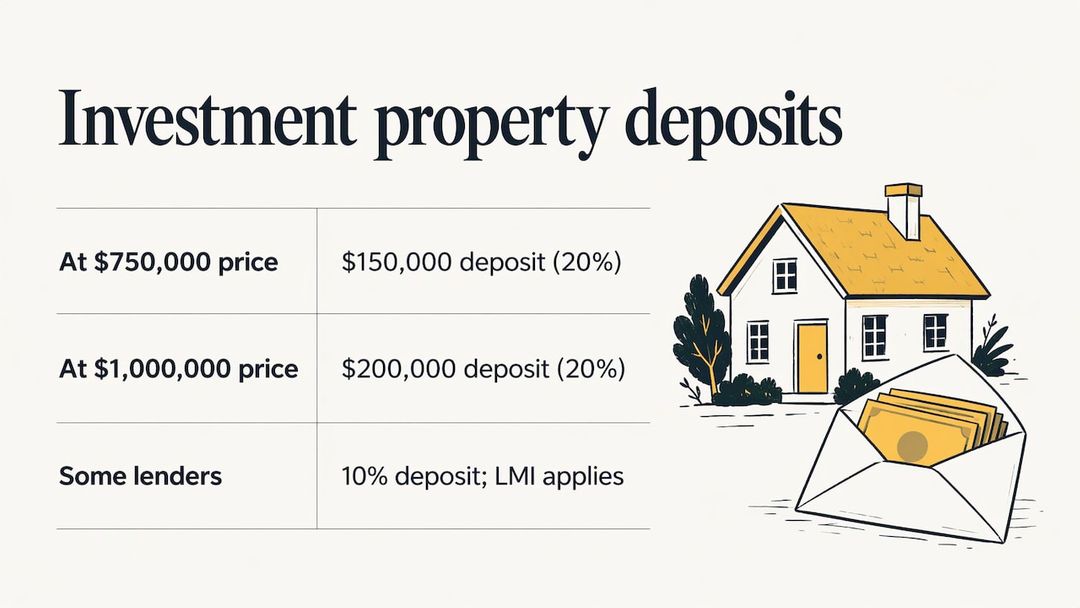
The deposit is not the whole cash requirement. You also need money for stamp duty, which is set by each state and territory (see how to calculate stamp duty), plus conveyancing (our conveyancer fees guide covers typical costs), building and pest inspections, and loan fees. Many first-time investors plan the deposit and forget these, then find the shortfall at exchange.
If you already own your home, equity can fund part or all of the deposit. Equity is the difference between your home's value and what you still owe on it. A lender will usually let you borrow against it, with the new loan secured on your existing property as well as the new one. Your broker can tell you how a lender would count that equity.
How lenders work out what you can borrow
This is where investors are most often surprised. Lenders do not simply multiply your salary. They run a serviceability test: could you still meet the repayments if things got harder?
The interest rate buffer
APRA, the regulator of Australian banks, sets out in its Prudential Practice Guide APG 223 that lenders should apply a serviceability buffer of at least 3.0 percentage points above the loan rate. It also says discounted introductory rates should be ignored in that test. So if your loan rate is 6.5%, the lender tests your repayments as if the rate were 9.5%. Rates change with the Reserve Bank's cash rate decisions and lender pricing, so use your own quote rather than a figure from an article.
Rental income is discounted
The same APRA guidance expects prudent lenders to discount most non-salary income, rent from investment properties included, by at least 20%. Here is a simple illustration:
- Expected rent: $500 a week, or $26,000 a year.
- Counted by the lender after a 20% discount: $20,800 a year.
The rest of the rent still pays your costs in real life, but it does not count as income for borrowing power. Moneysmart, the government's money guidance site, also warns against relying on rent to cover the mortgage, because the property may sit empty between tenants.
Your other debts and living costs
Credit card limits, car loans, HELP debts and personal loans all reduce what you can borrow, and so do your living expenses. Lenders look at the card limit, not the balance, so cancelling cards you do not use before applying can lift your borrowing power.
Debt-to-income limits from 2026
APRA announced that from 1 February 2026 banks and other authorised deposit-taking institutions may write no more than 20% of their new investment loans, and 20% of new owner-occupier loans, at a debt-to-income (DTI) ratio of six times income or more. DTI is your total debt divided by your gross income. The limit applies to the lender's overall book, not to you individually, and some lending is exempt, including finance for building or buying newly built homes.
For you, the practical effect is this: on a household income of $180,000, six times income is $1,080,000 of total debt including the new loan. Above that level, fewer lenders will have room to say yes, and the ones that do may price or assess the loan differently. A broker who sees what several lenders will accept on your numbers can save you a round of declined applications.
Interest-only or principal and interest
The two repayment types suit different strategies.
Principal and interest (P&I) repayments cover the interest and also pay down the loan, so you build equity through repayments as well as growth.
Interest-only repayments cover only the interest for a set period, so the balance stays the same. After that the loan reverts to P&I over the remaining term, and repayments rise.
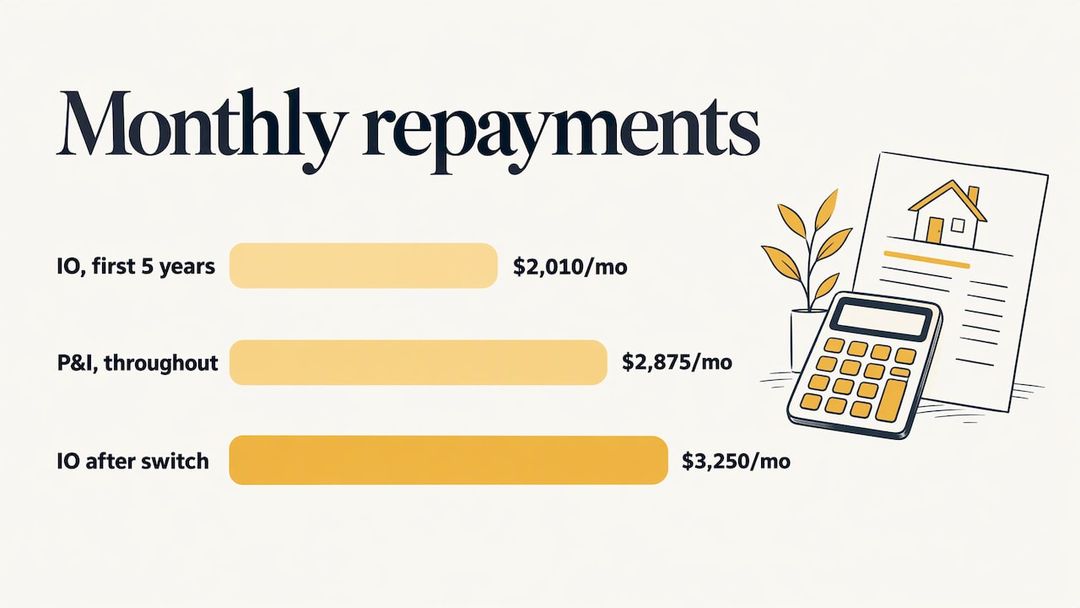
Moneysmart gives a worked example in its interest-only home loans guide. On a $500,000 loan over 25 years at a 4.8% comparison rate, interest-only costs $2,010 a month. After five years, when the loan switches to P&I, repayments jump to $3,250. A P&I loan on the same terms costs $2,875 a month throughout. Moneysmart notes that investors may benefit from higher tax deductions on interest, but the risks include no equity built during the interest-only period and repayments that become hard to meet later. The rate in that example is Moneysmart's illustration, not a current market rate.
Two points matter for approval:
- APRA's guidance says lenders should assess an interest-only loan on the P&I repayments that would apply over the remaining term after the interest-only period. That assessment is tougher than the repayment you will actually pay at first, so borrowing power can be lower than you expect.
- Interest-only terms and the maximum LVR for them vary by lender, so check the structure on your quote.
The tax side is worth settling before you choose. Interest on an investment loan is generally deductible against rental income, but how much you claim and when depends on your circumstances. A property tax accountant can model the effect of each structure before you sign.
Other loan features to compare
- Variable or fixed rate: variable rates move with the market and often allow extra repayments; fixed rates give certainty for a set period.
- Offset account: savings held against the loan reduce the interest charged. Offsets can be useful if you keep a buffer for vacancies and repairs.
- Split loan: part fixed, part variable.
- Separate loans for each property: many investors keep loans separate so each property can be refinanced or sold cleanly.
- SMSF borrowing: a self-managed super fund can borrow to buy an investment property under strict rules. That is a specialist area, so see SMSF loan experts rather than a standard investor loan.
The costs behind the loan
The interest rate is only one line. Moneysmart's guidance on buying an investment property lists the purchase costs (stamp duty, conveyancing and legal fees, searches, pest and building reports) and the running costs (council and water rates, building and landlord insurance, body corporate fees, land tax, property management fees and repairs).
When you compare loans, put these side by side:
| What to compare | Why it matters |
|---|---|
| Interest rate and comparison rate | The comparison rate folds many fees into one figure, so it shows the fuller cost |
| Upfront and ongoing fees | Application, settlement and monthly or annual package fees add up over the term |
| LMI | A one-off cost if your LVR is above 80% |
| Interest-only term | How long the lower repayment lasts before P&I begins |
| Offset and extra repayments | These can cut interest over time |
| Discount conditions | Some discounts depend on LVR or on holding a package |
Your own cash flow test is simple: add up loan repayments and all running costs, subtract the rent you can realistically expect after allowing for vacancy, and check you could carry the shortfall if rates rose.
How to get an investment property loan, step by step
1. Check your position
Work out your savings, equity, income and debts. Reduce card limits you do not need and avoid new credit. Pull your credit report so there are no surprises. Where a broker earns its keep here is in pointing out the changes that lift borrowing power before a lender sees your file.
2. Set a budget range and a strategy
Decide whether you are after rental yield, capital growth or both, and whether you will hold the property personally, in a trust or in an SMSF. The structure shapes which lenders suit you. On Real Estate Hive you can also find buyers agents who search for investment properties in your range.
3. Compare brokers and lenders
A mortgage broker can compare loans from a panel of lenders, which matters when each lender treats rental income, equity and interest-only differently. The directory lets you compare brokers side by side by their profiles and reviews, with city pages for Sydney, Melbourne and Hobart. Choose one who handles investor lending regularly.
4. Gather documents
Expect to provide:
- Recent payslips, or two years of tax returns and Notices of Assessment if you are self-employed (with financial statements for a business).
- Several months of savings and transaction statements.
- Statements for existing loans and credit cards.
- Photo ID.
- Details of any existing properties and their rent.
Incomplete paperwork is a common cause of delay.
5. Apply for pre-approval
Pre-approval, or conditional approval, tells you roughly how much a lender would lend before you shop. It is not a guarantee: it depends on the final valuation of the property and on your circumstances staying the same, and it usually lasts for a limited period, often around three months. Apply to one lender through your broker rather than to several at once, because multiple credit enquiries can affect your credit score.
6. Find the property and have it checked
Before you sign a contract, have the contract reviewed by a conveyancer or solicitor, and arrange building and pest inspections. Make sure the property is realistic for lenders: very small apartments, some rural land and properties with unusual features can be harder to finance.
7. Move to formal approval and settlement
Once you have a signed contract, the lender orders a valuation and gives formal approval if it comes in as expected. Settlement follows, when the loan is drawn and the property transfers into your name. Keep your income and debts steady until then.
8. Review the loan later
Rates and your equity both change. Refinancing a home loan when your interest-only period is ending, or when your property has grown in value, can lower repayments or release equity for the next purchase.
Finding the right professionals in one place
An investment loan involves a broker, often a buyers agent, a conveyancer and an accountant, and each affects the others. Real Estate Hive is an Australian directory where you can compare mortgage brokers, buyers agents, tax experts and SMSF lending specialists side by side, with detailed profiles and reviews, rather than piecing a team together across many websites. If you are a first-time investor, start with a broker, then add a tax expert before you choose a loan structure. Browse all categories on Real Estate Hive.

If you are planning to build or renovate, you can also compare builders in the same directory, which helps when the plan is to add value after you buy.
FAQ
How much deposit do I need for an investment property?
Most lenders look for about 20% of the purchase price, so $150,000 on a $750,000 property. Some will lend with a smaller deposit if you pay LMI, but your costs and borrowing needs rise. You also need cash for stamp duty and legal fees on top of the deposit.
Can I use my home's equity as the deposit?
Yes, many investors do. The lender values your existing home, and you can borrow against the difference between that value and your current loan, subject to its own serviceability test. A broker can show you how different lenders count that equity.
Is interest-only better for an investment property?
It depends on your plan. Interest-only keeps repayments lower for the set period and may suit investors who want higher tax deductions or cash flow, while P&I builds equity through repayments. Lenders assess interest-only on the higher P&I repayment, so it does not always raise what you can borrow. Discuss the tax effect with a property tax accountant.
How long does pre-approval last?
Pre-approval is typically valid for around three months, though the period varies by lender and you can usually ask for an extension. It is conditional on the final valuation and on your finances staying the same.
Sources
- APRA Prudential Practice Guide APG 223 Residential Mortgage Lending
- APRA: activation of debt-to-income limits
- Moneysmart: interest-only home loans
- Moneysmart: buying an investment property